
In modern industrial construction, infrastructure development, and commercial engineering, the demand for strong, durable, and cost-efficient structural materials continues to grow as projects become larger, more complex, and more safety-focused. Among the most widely used materials in this field, steel grating has become a fundamental solution for flooring systems, walkways, drainage covers, and platform structures due to its excellent balance of strength, ventilation, and long-term performance.
Unlike solid steel plates or concrete surfaces, steel grating is designed with an open-grid structure that allows light, air, water, and debris to pass through while still maintaining high load-bearing capacity. This unique combination of properties makes it highly suitable for environments where safety, durability, and maintenance efficiency are critical.
What is steel grating in engineering applications?
Steel grating is a fabricated metal structure composed of bearing bars and cross bars that are joined together through welding, pressing, or locking techniques to form a rigid grid panel. These panels are then installed onto supporting frames to create platforms, walkways, trench covers, stair treads, and industrial flooring systems.
Because of its structural design, steel grating distributes loads evenly across the surface while reducing overall material weight, making it a highly efficient solution for both light-duty and heavy-duty applications.
● It is manufactured in standardized or custom sizes depending on project requirements
● It can be produced using different bar spacing and thickness for load optimization
● It is compatible with multiple surface treatments for corrosion protection and safety enhancement
● It can be installed in modular systems for fast assembly and replacement
Why steel grating is preferred in modern industrial environments
Industrial environments require flooring systems that can withstand constant mechanical stress, exposure to chemicals, heavy traffic, and changing environmental conditions. Steel grating is widely used because it offers a combination of structural reliability and functional performance that traditional flooring systems often cannot provide.
● It allows efficient drainage of water, oil, and industrial liquids, reducing surface hazards
● It provides ventilation in enclosed industrial spaces, improving airflow and reducing moisture buildup
● It reduces structural dead load compared to solid flooring systems, improving overall engineering efficiency
● It enhances workplace safety through anti-slip surface options such as serrated bearing bars
● It supports long-term durability even under continuous heavy usage conditions
Main types of steel grating used in engineering projects
Steel grating is not a single uniform product but a category that includes several structural types designed for different applications and performance requirements.
Welded steel grating
Welded steel grating is produced by welding bearing bars and cross bars at high pressure and temperature, creating a strong and rigid structure suitable for heavy industrial loads.
● High structural strength and excellent load distribution capability
● Suitable for industrial platforms, walkways, and heavy-duty flooring systems
● Cost-effective solution for large-scale engineering projects
Press-locked steel grating
Press-locked grating is manufactured by mechanically pressing cross bars into bearing bars without welding, resulting in a smooth and precise surface.
● Clean appearance with uniform structure
● Suitable for architectural and commercial applications
● High dimensional accuracy and aesthetic performance
Serrated steel grating
Serrated grating includes tooth-like surfaces on bearing bars to improve friction and reduce slip risks in wet or oily environments.
● Enhanced anti-slip performance for safety-critical applications
● Widely used in outdoor platforms and industrial walkways
● Ideal for high-risk environments requiring additional traction
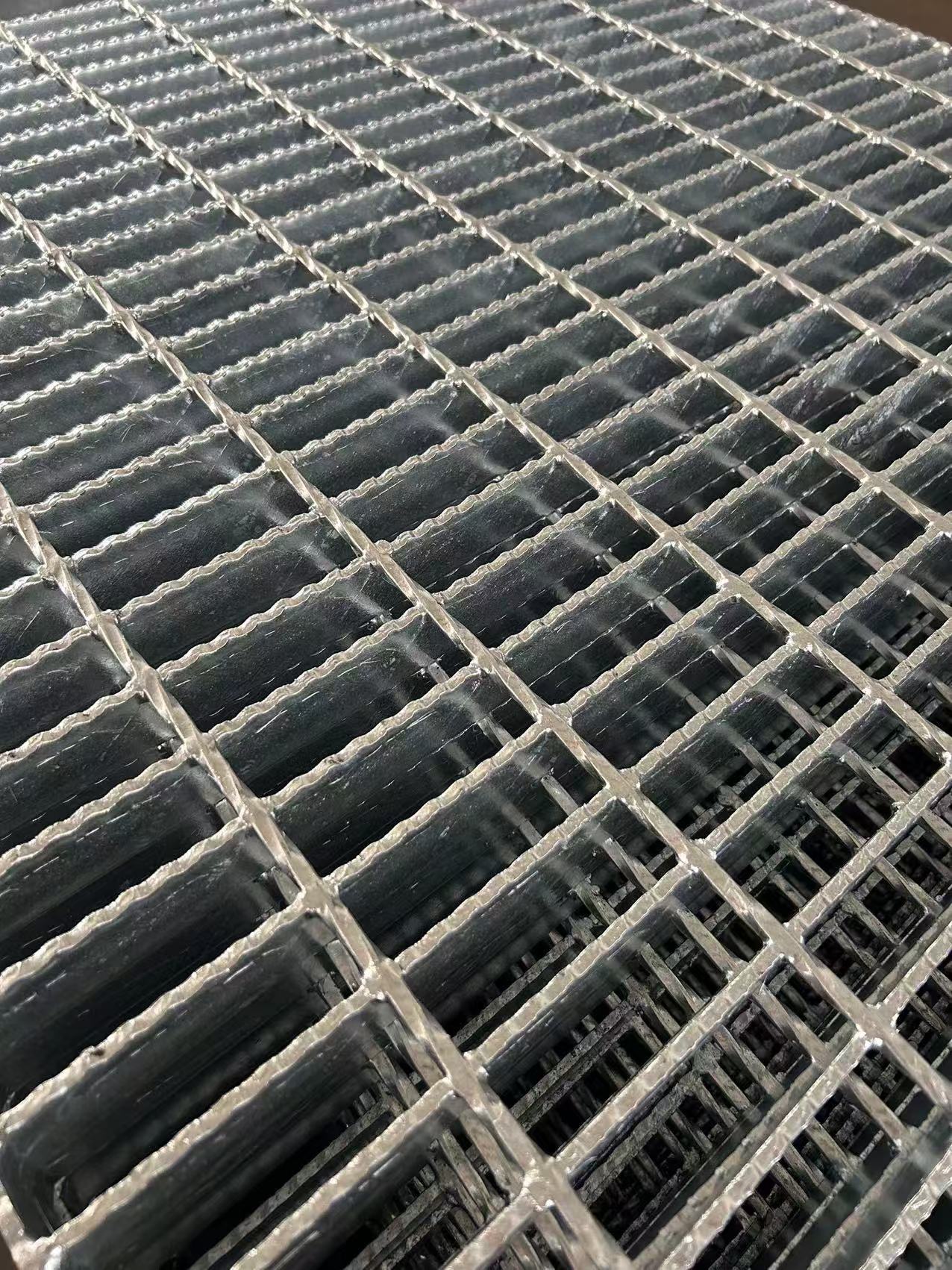
Key advantages of steel grating systems
Steel grating offers multiple engineering and economic benefits that make it one of the most efficient structural flooring materials in modern construction.
High strength and load distribution efficiency
● Designed to support heavy industrial loads without deformation
● Load is evenly distributed across bearing bars and supporting frames
● Suitable for both pedestrian and equipment traffic areas
Excellent environmental adaptability
● Performs well in indoor, outdoor, humid, and corrosive environments
● Compatible with protective coatings such as hot-dip galvanizing or stainless steel materials
● Resistant to temperature changes and mechanical stress
Improved safety performance
● Anti-slip surfaces reduce workplace accident risks
● Open structure prevents water accumulation and reduces slip hazards
● Stable design ensures safe movement of personnel and equipment
Easy installation and maintenance
● Modular panels allow fast installation and replacement
● Damaged sections can be replaced individually without dismantling the entire system
● Reduces long-term maintenance costs and downtime
Common applications of steel grating
Steel grating is widely used across multiple industries due to its versatility and durability.
● Industrial plants where machinery platforms and maintenance walkways are required
● Oil and gas facilities including refineries and offshore platforms
● Power generation plants for boiler platforms and turbine access systems
● Water treatment facilities where corrosion resistance and drainage performance are essential
● Transportation infrastructure such as bridges, airports, and railway stations
● Mining operations where heavy-duty load-bearing platforms are necessary
Material options and surface treatment solutions
The performance of steel grating is strongly influenced by the material and surface treatment used during manufacturing.
● Carbon steel grating offers high strength and cost efficiency for general industrial use
● Hot-dip galvanized steel grating provides long-term corrosion resistance for outdoor environments
● Stainless steel grating is used in highly corrosive or hygienic environments such as chemical plants and food processing facilities
● Painted or coated grating surfaces provide additional protection and aesthetic improvement
How steel grating improves project efficiency and lifecycle cost
Steel grating is not only a structural material but also a cost optimization solution in modern engineering projects.
● Reduces material usage due to lightweight yet strong design
● Lowers installation labor costs through modular construction
● Minimizes maintenance frequency and repair requirements
● Extends service life compared to conventional flooring materials
● Improves overall project efficiency through faster installation and adaptability
Conclusion
Steel grating has become an essential material in industrial and infrastructure engineering because it delivers a rare combination of strength, durability, safety, and cost efficiency. Its open-grid design improves drainage, ventilation, and workplace safety while maintaining strong load-bearing capabilities suitable for demanding environments.
For engineers, contractors, and B2B procurement teams, steel grating represents a reliable long-term investment that enhances operational efficiency while reducing lifecycle costs. As modern construction continues to prioritize modularity, safety, and sustainability, steel grating will remain a core solution across global industrial applications.
FAQ:
1. What is steel grating mainly used for?
Steel grating is mainly used for industrial platforms, walkways, drainage covers, stair treads, and structural flooring systems requiring strength and ventilation.
2. What are the main advantages of steel grating?
It offers high strength, excellent drainage, anti-slip safety options, long service life, and easy installation and maintenance.
3. What materials are commonly used for steel grating?
Common materials include carbon steel, hot-dip galvanized steel, and stainless steel depending on environmental conditions and project requirements.
4. Is steel grating suitable for outdoor use?
Yes, especially hot-dip galvanized and stainless steel grating, which provide strong corrosion resistance for outdoor and harsh environments.
Post time: Jun-09-2026