
Industrial stairs are used every day in factories, platforms, warehouses, power plants, wastewater treatment plants, and outdoor service areas. Unlike flat walkways, stair areas place more pressure on each step because every movement depends on stable foot contact. When the surface becomes wet, oily, dusty, or exposed to weather, ordinary stair materials may increase slipping risks.
Stair Treads Steel Bar Gratings are designed to provide a stronger and safer walking surface for industrial stair systems. With an open-grid structure, stable bearing bars, optional serrated surfaces, and suitable fixing methods, steel bar grating stair treads can support safe access while allowing drainage, ventilation, and long-term use in demanding environments.
For industrial projects, stair tread selection should not only focus on size. Surface safety, load capacity, corrosion resistance, installation method, and edge design are all important factors.
What Problems Can Poor Stair Tread Selection Cause?
In industrial environments, stair treads often face harsher conditions than they appear to. A stair system may look simple, but poor tread selection can lead to practical problems during daily use.
| Site Issue | Possible Result | Better Stair Tread Design |
|---|---|---|
| Smooth surface in wet areas | Higher slipping risk | Serrated steel bar grating surface |
| Poor drainage | Water stays on the step | Open-grid structure |
| Weak fixing method | Tread movement or noise | Side plates and proper bolt fixing |
| Unsuitable material | Faster corrosion outdoors | Hot-dip galvanized or stainless steel option |
| Wrong tread size | Uncomfortable or unsafe stepping | Customized width and length |
| No front edge protection | Reduced foot contact at step edge | Anti-slip nosing |
A well-designed stair tread helps solve these problems before they affect daily operation.
Why Steel Bar Grating Works Well for Industrial Stairs
Steel bar grating is widely used for stair treads because it provides a balance between strength, drainage, and safety. Compared with solid plates, the open-grid surface allows rainwater, dust, and small debris to pass through. This helps reduce accumulation on the step surface and makes the stairway easier to maintain.
In outdoor areas, this feature is especially useful. Rainwater can drain through the openings instead of staying on the tread. In factories or equipment rooms, dust and small particles are less likely to remain on the walking surface.
The bearing bars provide the main load support, while the cross bars help keep the structure stable. When used with side plates, the tread can be fixed securely to the stair stringers, forming a reliable stair system for industrial access.
Anti-Slip Design Is Important for Every Step
Stair areas require stronger anti-slip consideration than normal platforms. When workers go up or down stairs, foot pressure is concentrated on each tread. If the front edge is smooth or wet, the risk of slipping increases.
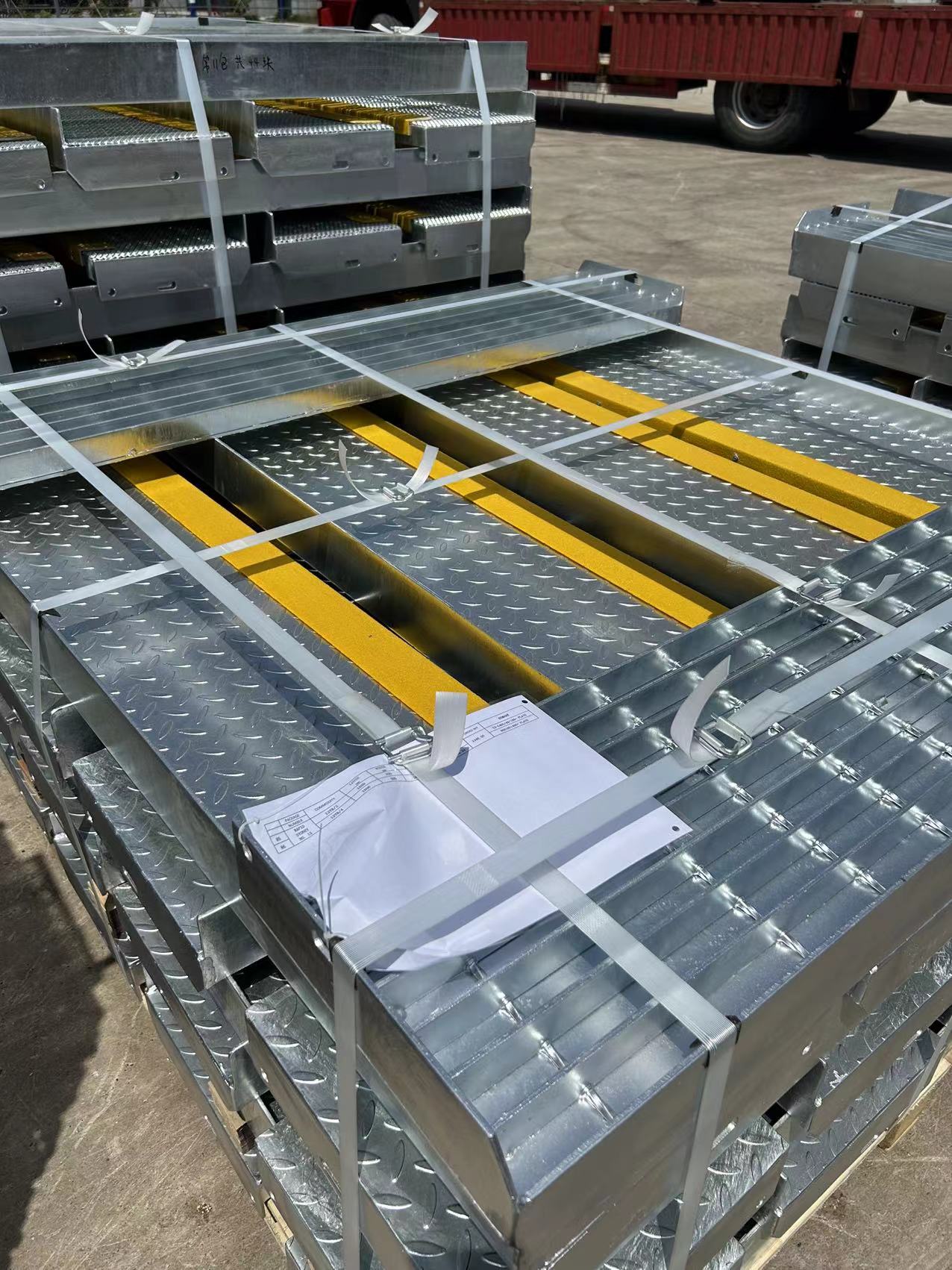
Stair Treads Steel Bar Gratings can improve safety through several design options:
- Serrated bearing bars
- Anti-slip nosing
- Open-grid drainage
- Proper tread depth
- Stable side plate fixing
- Suitable surface treatment
Serrated grating is often selected for wet, oily, or outdoor environments. Anti-slip nosing can provide extra grip at the front edge of the step, where foot contact is most important. These details make the stair system safer for frequent use.
Choosing the Right Stair Tread Size
A stair tread must match the stair structure. If the tread is too narrow, walking may feel unsafe. If it is too long without proper support, the structure may not perform well. If the fixing holes do not match the stair stringers, installation becomes more difficult.
Before production, several details should be confirmed:
- Tread width
- Tread length
- Bearing bar direction
- Side plate size
- Fixing hole position
- Load requirement
- Stair angle
- Indoor or outdoor environment
Customized stair treads can be produced according to project drawings, helping reduce installation problems and improving final fit.
Surface Treatment for Different Environments
The working environment determines the suitable surface treatment.
Hot-dip galvanized Stair Treads Steel Bar Gratings are commonly used in outdoor, humid, and industrial environments. The zinc coating helps improve corrosion resistance and supports longer service life.
Carbon steel stair treads can be used in general indoor industrial areas where corrosion risk is lower.
Stainless steel stair treads are suitable for chemical plants, coastal projects, food processing areas, and environments where stronger corrosion resistance or a cleaner appearance is required.
For high-risk walking areas, surface treatment should be considered together with anti-slip design, not separately.
Where Stair Treads Steel Bar Gratings Are Commonly Used
Steel bar grating stair treads are suitable for many industrial and commercial access systems, including:
- Factory stairways
- Platform access stairs
- Outdoor service stairs
- Power plant stairs
- Wastewater treatment plant stairs
- Chemical plant stair systems
- Warehouse access stairs
- Equipment maintenance stairs
- Steel structure buildings
- Drainage and utility service areas
In these applications, stair treads need to provide stable support, safe foot contact, and reliable performance under frequent use.
Our Stair Treads Steel Bar Gratings Product Support
Our Stair Treads Steel Bar Gratings can be customized according to different industrial stair projects. We can adjust tread length, width, bearing bar specification, spacing, side plate design, fixing hole position, surface type, material, and surface treatment.
For outdoor stairways, hot-dip galvanized treatment can improve corrosion resistance. For wet or oily areas, serrated steel grating and anti-slip nosing can provide better walking safety. For customized steel structures, stair treads can be matched with platforms, steel grating walkways, frames, and other support components.
Our related steel products also include Press-Welded Steel Grating, Plug-in Steel Grating, Serrated Steel Grating, Heavy Duty Steel Grating, Light Steel Grating, Fan-Shaped Steel Grating, Anti-Slip Steel Grating, Steel Grating Platform, Trench Cover, Angle Steel Embedded Part, Steel Pallet, and customized steel structures.
By matching stair tread design with the actual stair system, the final structure can be safer, easier to install, and more reliable for long-term use.
Conclusion
Stair Treads Steel Bar Gratings are an important part of industrial access safety. A suitable tread design can improve grip, support drainage, reduce surface accumulation, and provide stable load-bearing performance for stair systems.
For factories, outdoor platforms, wastewater treatment plants, chemical facilities, warehouses, and steel structures, stair tread selection should consider more than basic size. Anti-slip surface, fixing method, material, surface treatment, and project fit all affect long-term performance.
With proper design and customization, steel bar grating stair treads can create safer and more durable access routes for industrial projects.
FAQ
1. What are Stair Treads Steel Bar Gratings used for?
Stair Treads Steel Bar Gratings are used for industrial stairways, platform access stairs, outdoor service stairs, factory stairs, warehouse stairs, and equipment maintenance stairs.
2. Can steel bar grating stair treads be anti-slip?
Yes. Serrated bearing bars and anti-slip nosing can be added to improve grip, especially in wet, oily, or outdoor areas.
3. Can stair treads be hot-dip galvanized?
Yes. Hot-dip galvanized stair treads are commonly used outdoors and in humid industrial environments because they provide better corrosion resistance.
4. Can Stair Treads Steel Bar Gratings be customized?
Yes. Width, length, bearing bar specification, spacing, side plates, fixing holes, material, surface treatment, and anti-slip design can be customized according to project drawings.
Post time: Aug-06-2026