
Industrial Steel Grating is widely used in factory walkways, equipment platforms, wastewater treatment facilities, chemical processing areas, drainage systems, warehouse passages, and heavy industrial sites. Although all of these areas may use steel grating, their requirements for load capacity, slip resistance, corrosion resistance, drainage, and structural support can be very different. Using the same grating specification throughout an entire project is therefore not always the best approach.
A more practical selection method is to begin with the actual working environment and then determine the appropriate grating structure. A dry inspection platform used only by workers has very different requirements from an area continuously exposed to wastewater, oil, or chemicals. Likewise, a normal pedestrian walkway and a heavy equipment area experience very different types of loads.
The key to selecting Industrial Steel Grating is not simply finding the strongest option, but choosing a structure that properly matches the actual operating conditions.
Selecting Industrial Steel Grating for Different Working Environments
At the beginning of a project, the main site conditions can be used to identify a suitable grating type before determining the bearing bar size, spacing, material, and surface treatment.
| Working Environment | Main Requirement | Suitable Grating Type | Key Design Focus |
|---|---|---|---|
| General factory walkway | Stable daily access | Press-Welded Steel Grating | Support span, load, and spacing |
| Wet or oily area | Slip resistance and drainage | Serrated Steel Grating | Surface grip and liquid drainage |
| Heavy equipment area | Higher load capacity | Heavy Duty Steel Grating | Bearing bar size, concentrated loads, and support |
| Light maintenance area | Lower weight and easier installation | Light Steel Grating | Avoid unnecessary over-design |
| Chemical or corrosive environment | Long-term corrosion resistance | Stainless Steel Grating | Material compatibility with the environment |
| Outdoor platform | Corrosion and weather resistance | Hot-Dip Galvanized Steel Grating | Long-term exposure to rain and humidity |
| Tank or silo surroundings | Fit curved structures | Fan-Shaped Steel Grating | Radius, angle, and support layout |
| Drainage trench or equipment pit | Drainage and safe covering | Steel Grating Trench Cover | Opening size, frame support, and maintenance access |
This table provides an initial reference, but the final specification should still be determined according to actual load conditions, support span, and installation structure.
General Factory Areas: Avoid Unnecessary Over-Design
General factory walkways, equipment inspection platforms, and warehouse passages usually need to support workers, light tools, and occasional maintenance equipment. In these areas, the main requirements are stability, safe access, and convenient maintenance rather than maximum structural strength.
The first step is to determine how frequently the walkway will be used, whether small carts or tools will pass over it, the distance between support beams, and whether the panels need to be removed for maintenance. When the actual load is moderate, standard press-welded steel grating can often provide sufficient performance without adding unnecessary weight.
Using Heavy Duty Steel Grating throughout every area may theoretically increase strength, but it also increases panel weight, handling difficulty, installation labor, and support structure requirements. In areas without heavy loads, these additional costs and structural requirements may not provide meaningful benefits.
The selection focus for general industrial areas should therefore be to meet the actual load requirement without adding unnecessary structural weight.
Wet and Oily Areas: Drainage and Slip Resistance Should Be Considered Together
In many industrial platforms, the main problem is not insufficient load capacity but reduced walking safety caused by water, oil, cleaning liquids, or process residue.
The open structure of steel grating naturally provides good drainage because liquids can pass through the openings instead of remaining on the walking surface. However, when workers frequently move through wet or oily areas, drainage alone may not provide enough safety. Surface traction also becomes important.
Wastewater treatment platforms, pump stations, chemical walkways, equipment washing zones, and outdoor maintenance platforms can therefore benefit from Serrated Steel Grating. Serrated bearing bars improve friction between footwear and the grating surface, while the open structure allows liquids to drain away efficiently. The two features address different aspects of the same working condition.
For outdoor wet environments, hot-dip galvanizing can also be added. It is important to distinguish the functions: galvanizing mainly improves corrosion resistance, while serrated bearing bars improve slip resistance. One does not replace the other.
Heavy Equipment Areas: Concentrated Loads Matter More Than Total Weight Alone
Heavy industrial areas require more careful evaluation because the platform may support equipment, maintenance tools, carts, or other concentrated loads.
A common mistake is to focus only on the total weight. In practice, where and how the load is applied can be just as important as the total load.
A load distributed across several panels behaves differently from an equipment leg applying force to a small area. The concentrated load can create much higher local stress even when the total equipment weight is not exceptionally high.
Heavy Duty Steel Grating should therefore be selected by considering factors such as the maximum load, location of concentrated loads, bearing bar span, bearing bar height and thickness, support beam spacing, load direction, and frequency of use.
The support frame must also be evaluated. Even a strong heavy-duty grating panel may deform or vibrate if the underlying frame does not provide sufficient support. High-load applications should therefore treat the grating and support structure as one complete system.
Corrosive Environments: Material Selection Should Follow the Actual Exposure
Outdoor rain, continuous humidity, wastewater, and chemical exposure can all affect the service life of Industrial Steel Grating. Corrosion protection should therefore involve more than simply deciding whether a surface coating is required.
For general outdoor and humid industrial environments, hot-dip galvanized carbon steel grating is a common solution. The zinc coating protects the underlying steel and helps slow corrosion during long-term exposure.
Where stronger chemical exposure, coastal conditions, food-processing requirements, or higher hygiene standards are involved, stainless steel grating may be more appropriate. Material selection should consider the type of liquid or chemical present, humidity, cleaning frequency, maintenance conditions, and expected service life.
Waiting until serious corrosion has already developed before changing materials often results in additional shutdown, removal, and replacement work. Selecting the correct material during the early project stage is usually more effective.
Drainage Areas: Larger Openings Are Not Always Better
Industrial Steel Grating is frequently installed above drainage trenches, equipment pits, wastewater channels, and process-water areas. In these applications, the grating has to perform two functions at the same time: allow liquids to pass through efficiently and provide a stable surface for personnel or maintenance access.
Larger grid openings may improve drainage capacity, but they can also increase the risk of small tools falling through, reduce comfortable foot contact, or create problems for small cart wheels. Grid spacing should therefore be selected according to both drainage requirements and the way the area will actually be used.
For drainage channels that require regular cleaning, panel size and weight should also be considered. An oversized panel may meet the structural requirement but become inconvenient to lift and remove during maintenance.
Where vehicles or forklifts cross the drainage area, ordinary pedestrian trench grating should not be used without first checking wheel loads, support spacing, and frame strength.
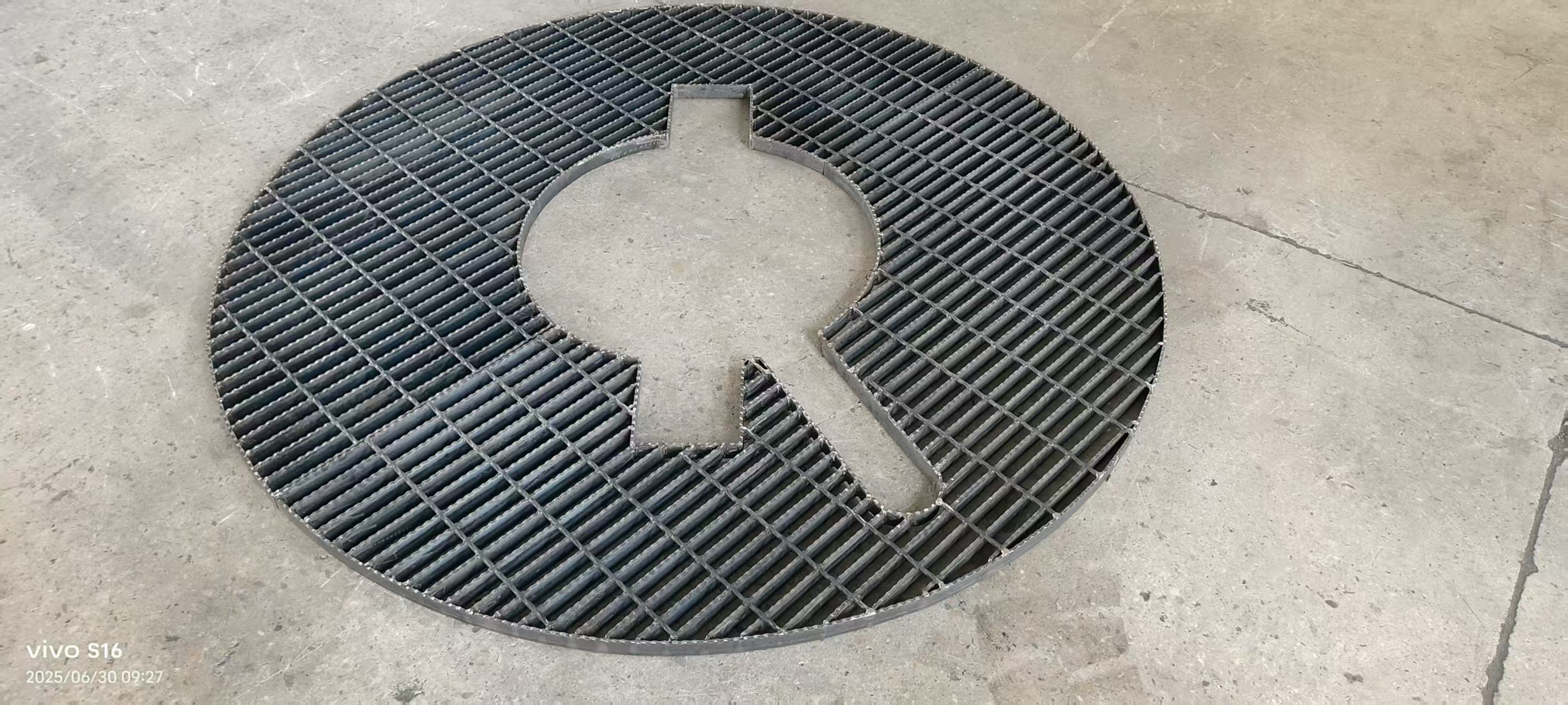
Irregular Structures: Do Not Leave Every Adjustment to On-Site Cutting
Industrial projects often include tanks, silos, equipment foundations, pipes, and columns that interrupt standard rectangular platform layouts.
Using only standard rectangular panels and cutting them extensively on site can result in additional material waste, uneven edges, damaged protective coatings, and more installation work. More importantly, cutting through bearing bars without restoring edge support may reduce local structural stability.
For tank and silo surroundings, Fan-Shaped Steel Grating can be produced to follow curved layouts. Openings for pipes, equipment columns, and access points can also be incorporated into the panel design according to project drawings, including suitable edge treatment.
Useful drawing information should include not only the outside dimensions but also bearing bar direction, equipment opening locations, support frame layout, and panel division. These details have a direct impact on installation accuracy and structural performance.
Matching Different Industrial Steel Grating Products to Actual Working Conditions
Different parts of an industrial project can use different grating products according to their actual requirements instead of applying one structure throughout the entire site.
Our product range includes:
- Press-Welded Steel Grating for general industrial walkways and platforms;
- Serrated Steel Grating for wet, oily, and high-slip-risk areas;
- Heavy Duty Steel Grating for higher loads and equipment zones;
- Light Steel Grating for inspection and light-duty access;
- Fan-Shaped Steel Grating for tanks, silos, and circular structures;
- Anti-Slip Steel Grating for high-risk walking areas;
- Steel Grating Platforms, Stair Treads Steel Bar Gratings, and Trench Covers;
- Angle Steel Embedded Parts, steel frames, and custom-shaped grating panels.
Panel dimensions, bearing bar specifications, grid spacing, materials, surface treatments, edge finishing, and equipment openings can all be adjusted according to project drawings and real operating conditions.
The purpose is not to apply the same specification everywhere, but to match each area with the structure it actually needs.
Conclusion
Correct Industrial Steel Grating selection requires load conditions, support span, slip resistance, corrosion environment, drainage requirements, installation method, and maintenance access to be considered together.
General factory walkways do not always need heavy-duty structures. Wet platforms require more than drainage alone. Equipment areas need careful evaluation of concentrated loads. Corrosive environments should be matched with suitable materials from the beginning, while irregular platforms should minimize unnecessary on-site cutting.
By matching the steel grating structure to the actual working environment, industrial projects can achieve a better balance between safety, structural efficiency, maintenance convenience, and long-term performance.
FAQ
1. Which Industrial Steel Grating is suitable for wet environments?
Serrated Steel Grating is often suitable for wet areas because its open-grid structure supports drainage while the serrated bearing bars improve surface grip. Outdoor wet environments can also use hot-dip galvanized treatment to improve corrosion resistance.
2. When is Heavy Duty Steel Grating required?
Heavy Duty Steel Grating should be considered when an area is exposed to higher loads, concentrated equipment loads, heavy cart traffic, or larger support spans. The supporting frame should also be checked to ensure it matches the required load.
3. Can Industrial Steel Grating be customized around equipment?
Yes. Fan-shaped, irregular, or pre-cut grating panels can be produced according to drawings for tanks, pipes, equipment columns, and access openings, reducing on-site cutting and installation adjustment.
4. Can one industrial project use several different steel grating types?
Yes. This is often more practical. General walkways may use press-welded grating, wet areas may use serrated grating, high-load zones may use heavy-duty grating, and equipment or tank surroundings may use custom-shaped grating.
Post time: Aug-11-2026