
Chemical Plant Steel Grating is exposed to more than ordinary industrial loads. In chemical plants, the same grating may need to withstand moisture, washdown water, corrosive liquids, chemical vapors, oil contamination, outdoor weather, and frequent maintenance traffic.
Because these exposures vary significantly from one process area to another, selecting grating only by load capacity is not enough. Material, surface treatment, drainage, slip resistance, support structure, and maintenance access should all reflect the actual operating environment.
A useful way to evaluate chemical plant grating is to divide the facility into exposure zones rather than treating the entire plant as one environment.
Chemical Plant Grating Exposure Matrix
| Plant Area | Main Exposure | Typical Grating Requirement | Main Design Concern |
|---|---|---|---|
| General process walkway | Humidity, light contamination | Galvanized steel grating | Corrosion protection and access |
| Pump and valve area | Leakage, oil, process liquid | Serrated grating | Drainage and slip resistance |
| Chemical dosing area | Chemical splash | Material selected by chemical compatibility | Corrosion resistance |
| Tank platform | Weather, vapor, maintenance traffic | Galvanized or stainless steel grating | Corrosion, load, and access |
| Washdown area | Frequent water and cleaning | Serrated open grating | Fast drainage and grip |
| Pipe rack access | Outdoor weather and inspection traffic | Galvanized steel grating | Long-term outdoor exposure |
| Drainage channel | Process water and residue | Grating trench cover | Drainage and removable access |
| Highly corrosive zone | Aggressive chemical exposure | Stainless or other compatible solution | Material compatibility |
This matrix is only a starting point. The exact chemical, concentration, temperature, exposure time, and cleaning method should be checked before the final material is selected.
Corrosion Risk Depends on More Than the Chemical Name
A common mistake is to classify an entire chemical plant as simply “corrosive.” In reality, corrosion severity can vary greatly even within the same production line.
Four factors are especially useful when evaluating a grating location:
Chemical concentration
A low-concentration splash and continuous contact with a concentrated chemical do not create the same material requirement.
Temperature
Higher operating temperatures can accelerate many corrosion processes. A material suitable at room temperature may perform differently around heated process equipment.
Contact time
Occasional droplets that are quickly removed are very different from liquid that remains trapped around supports or edges for long periods.
Wet-dry cycles
Repeated wetting and drying can create persistent corrosion problems, particularly around joints, clips, frames, and poorly drained areas.
For this reason, Chemical Plant Steel Grating should be evaluated according to the actual exposure condition, not simply the name of the chemical plant.
Hot-Dip Galvanized Steel Is Useful, but Not Universal
Hot-dip galvanized steel grating is widely used in industrial plants because the zinc coating provides effective corrosion protection in many outdoor, humid, and general process environments.
It is often suitable for:
- General process walkways
- Outdoor platforms
- Pipe rack access
- Tank inspection areas
- Utility sections
- Areas exposed mainly to water and humidity
However, galvanizing should not automatically be specified for every chemical zone.
Certain acidic or strongly alkaline environments can attack zinc coatings more aggressively. Where regular chemical splash or continuous chemical exposure is expected, the compatibility of the coating with the actual process medium should be checked.
This is an important distinction because “galvanized” does not mean “resistant to every chemical.”
Stainless Steel Should Also Be Selected by Exposure
Stainless steel grating is commonly considered for chemical processing areas because of its corrosion resistance, but stainless steel is not a single universal solution either.
Its performance depends on the stainless grade and the environment.
For example, factors such as chlorides, acids, operating temperature, cleaning chemicals, and continuous moisture can influence material performance. In demanding environments, the specific stainless grade should therefore be matched to the process conditions rather than selected only because it is described as stainless steel.
This makes chemical compatibility data especially important for dosing platforms, tank areas, wash zones, and locations close to aggressive process media.
Slip Risk Often Appears Before Structural Problems
Chemical plant platforms frequently remain structurally sound while becoming unsafe to walk on because of oil, condensate, water, chemical residue, or cleaning liquids.This means anti-slip design should be considered separately from corrosion protection.
A useful distinction is:
Material or coating controls corrosion.
Surface profile helps control slip risk.
Open-grid structure helps remove liquids.
In wet or contaminated process areas, serrated steel grating can provide more surface grip than a smooth bearing bar. The open-grid structure also helps liquids leave the walking surface instead of forming large puddles.
This combination is particularly useful around pumps, valves, reactors, cleaning stations, and wastewater handling areas.
The Most Vulnerable Area May Be the Support, Not the Grating Panel
Chemical plant grating is often evaluated by looking at the panel surface, but corrosion problems can develop first around the supporting structure.
Particular attention should be given to:
- Panel edges
- Support angles
- Steel frames
- Fixing clips
- Welded joints
- Drainage channel frames
- Areas where liquid can remain trapped
If a corrosion-resistant grating panel is installed on an unsuitable support frame, the overall platform may still have a short service life.
The grating, frame, fasteners, and embedded components should therefore be considered together when the area is exposed to corrosive liquids or frequent washdown.
Drainage Design Can Reduce Chemical Exposure Time
Drainage is not only a housekeeping issue in chemical plants. It can also influence how long process liquids remain in contact with metal surfaces.
A platform that allows liquid to pass through quickly can reduce surface accumulation, but the liquid still needs somewhere to go. If process fluid drains through the grating and collects on the supporting beams below, corrosion may simply move from the walking surface to the structural frame.
A more complete design should therefore consider:
- Grating opening
- Floor slope
- Drainage direction
- Channel location
- Support beam position
- Access for cleaning
This is especially relevant around pumps, dosing systems, mixing equipment, and washdown areas.
Where Different Grating Products Fit in a Chemical Plant
A chemical plant may require several grating structures within the same project rather than one specification throughout.
Press-Welded Steel Grating can be used for general access areas where standard industrial strength and ventilation are required.
Serrated Steel Grating is better suited to wet, oily, or contaminated walking surfaces.
Heavy Duty Steel Grating can be used where maintenance equipment, higher loads, or concentrated loads are present.
Stainless Steel Grating may be selected for areas where the chemical environment requires greater corrosion resistance.
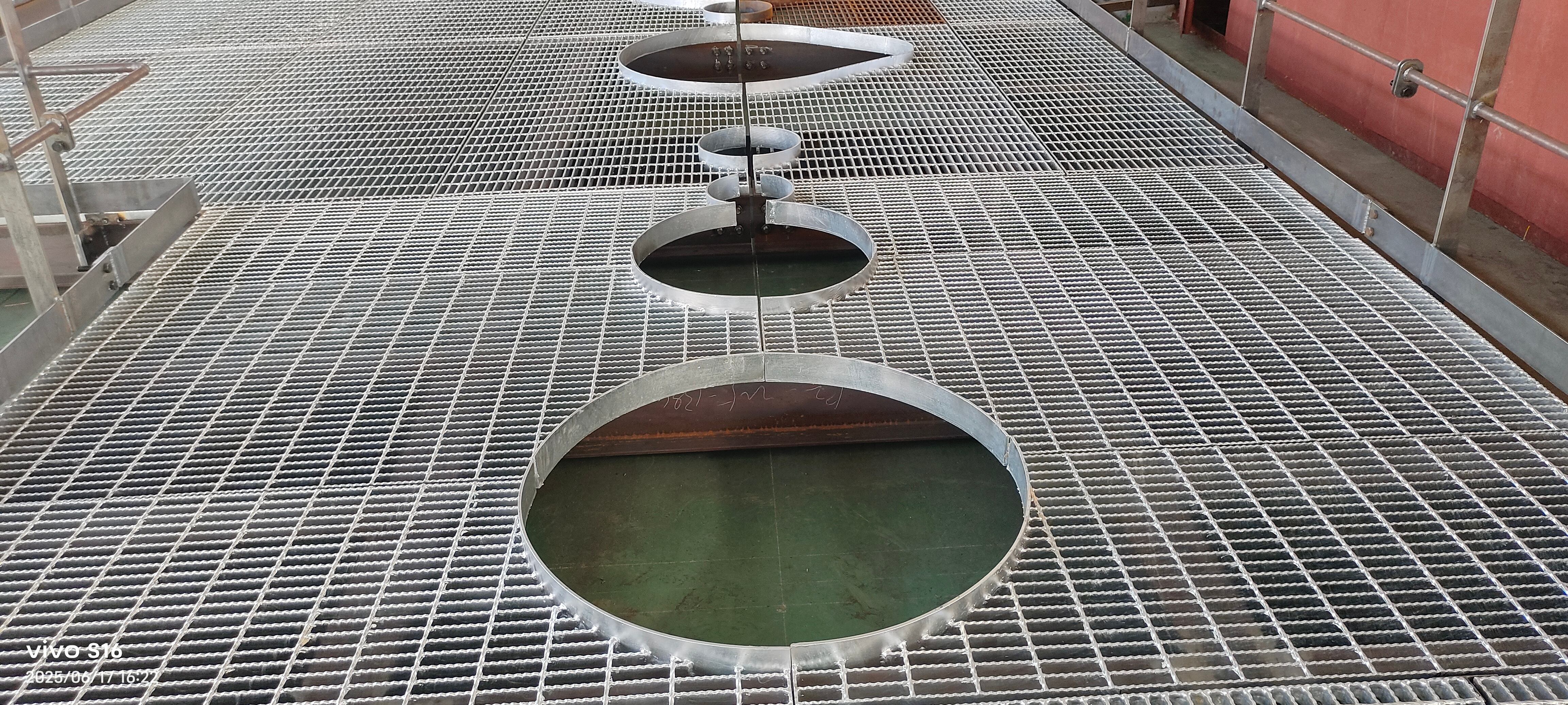
Fan-Shaped Steel Grating can fit around tanks, reactors, and circular equipment platforms.
Trench Covers and removable grating panels provide access to process drainage and underground service areas.
For custom chemical plant projects, panel size, bearing bar specification, openings, surface treatment, support frames, and edge structures can be produced according to project drawings and actual process conditions.
A Better Specification Starts With Site Data
Before Chemical Plant Steel Grating is specified, the most useful project information is not simply the required panel dimensions.
More valuable information includes the operating area, expected load, support span, chemical exposure, temperature, indoor or outdoor location, washdown frequency, slip conditions, equipment openings, and maintenance requirements.
When these conditions are known, material and structural decisions can be made based on actual risk rather than assumptions.
Conclusion
Chemical Plant Steel Grating should be selected according to the exposure of each process area rather than applying one material throughout the facility.
General outdoor sections may only require galvanized grating, while splash zones, washdown areas, heavy-load platforms, and highly corrosive locations can require very different solutions. Chemical compatibility, drainage, slip resistance, support structure, and maintenance access should all be evaluated together.
The most reliable approach is to treat each plant area as a separate combination of load + corrosion + liquid exposure + maintenance conditions and then match the grating structure to that environment.
FAQ
1. Is galvanized steel grating suitable for chemical plants?
It can be suitable for general process areas, outdoor platforms, and humid environments, but compatibility should be checked when the grating is exposed to aggressive acids, alkalis, or other chemicals.
2. Is stainless steel always better for chemical plant grating?
No. Stainless steel performance depends on the grade and the actual chemical, concentration, temperature, and exposure conditions. Material compatibility should be evaluated for the specific process.
3. Why is serrated grating useful in chemical plants?
Serrated grating provides additional surface grip in areas exposed to water, oil, condensate, or process residue, while its open structure supports drainage.
4. What information is needed before selecting Chemical Plant Steel Grating?
Important information includes load, support span, chemical exposure, temperature, wet or dry conditions, cleaning frequency, corrosion level, slip risk, and platform layout.
Post time: Aug-13-2026