
Steel Grating for Walkways is commonly used in factories, industrial plants, warehouses, power facilities, wastewater treatment plants, and outdoor working areas. Compared with solid flooring, steel grating provides an open walking surface that allows water, dust, and small debris to pass through while providing a durable route for daily personnel access.
However, a practical steel grating walkway depends on more than the grating itself. The way people use the route, the supporting structure, surface conditions, equipment around the walkway, and future maintenance requirements all need to be considered before fabrication. Getting these details right can reduce installation problems and improve the long-term usability of the access route.
Start With the Actual Use of the Walkway
The first question is not which grating type to choose, but how the walkway will be used. A maintenance passage around machinery may only need occasional access, while a main plant walkway may be used continuously by workers carrying tools, inspecting equipment, or moving between different operating areas.
The layout should therefore account for pedestrian direction, expected traffic, nearby equipment, doors, stairs, handrails, and maintenance points. If workers need to carry materials or work beside the walkway, the available space should reflect those activities rather than being based only on the minimum passage width.
This approach also helps determine whether a standard panel layout is sufficient or whether the walkway requires customized dimensions or openings.
Select the Grating Type Based on the Working Conditions
Different industrial environments can require different grating configurations. Press-welded grating is widely used for general industrial access, while serrated grating can provide additional traction where the surface may become wet, oily, or contaminated.
For outdoor applications, corrosion protection becomes another important consideration. Hot-dip galvanized steel grating is commonly selected for exposed structures because the zinc coating helps protect the steel from environmental corrosion. In more aggressive environments, stainless steel may be considered depending on the chemicals, moisture, and required service life.
The objective is not to use the most specialized grating everywhere, but to match the product to the conditions in which it will actually operate.
Support Layout Determines How the Walkway Feels Underfoot
Even when the grating specification is suitable, poor support planning can affect the finished walkway. The distance between supporting beams, the span direction of the bearing bars, and the way panels are seated on the structure all influence deflection and walking stability.
For this reason, support spacing should be established before the final grating dimensions are confirmed. A manufacturer working from project drawings can take the support arrangement into account when preparing panel sizes and span direction.
For long walkways, panel segmentation is also worth considering. Smaller practical sections can make transportation, lifting, installation, inspection, and future replacement easier than unnecessarily large panels.
Plan Equipment Openings Before Fabrication
Industrial walkways rarely have a completely clear path. Pipes, valves, cables, ducts, columns, machines, and access points often occupy part of the available space.
If these obstacles are discovered only after the grating has been installed, workers may need to cut panels on site or modify the surrounding structure. Planning the openings during fabrication allows the grating to follow the actual equipment layout more accurately.
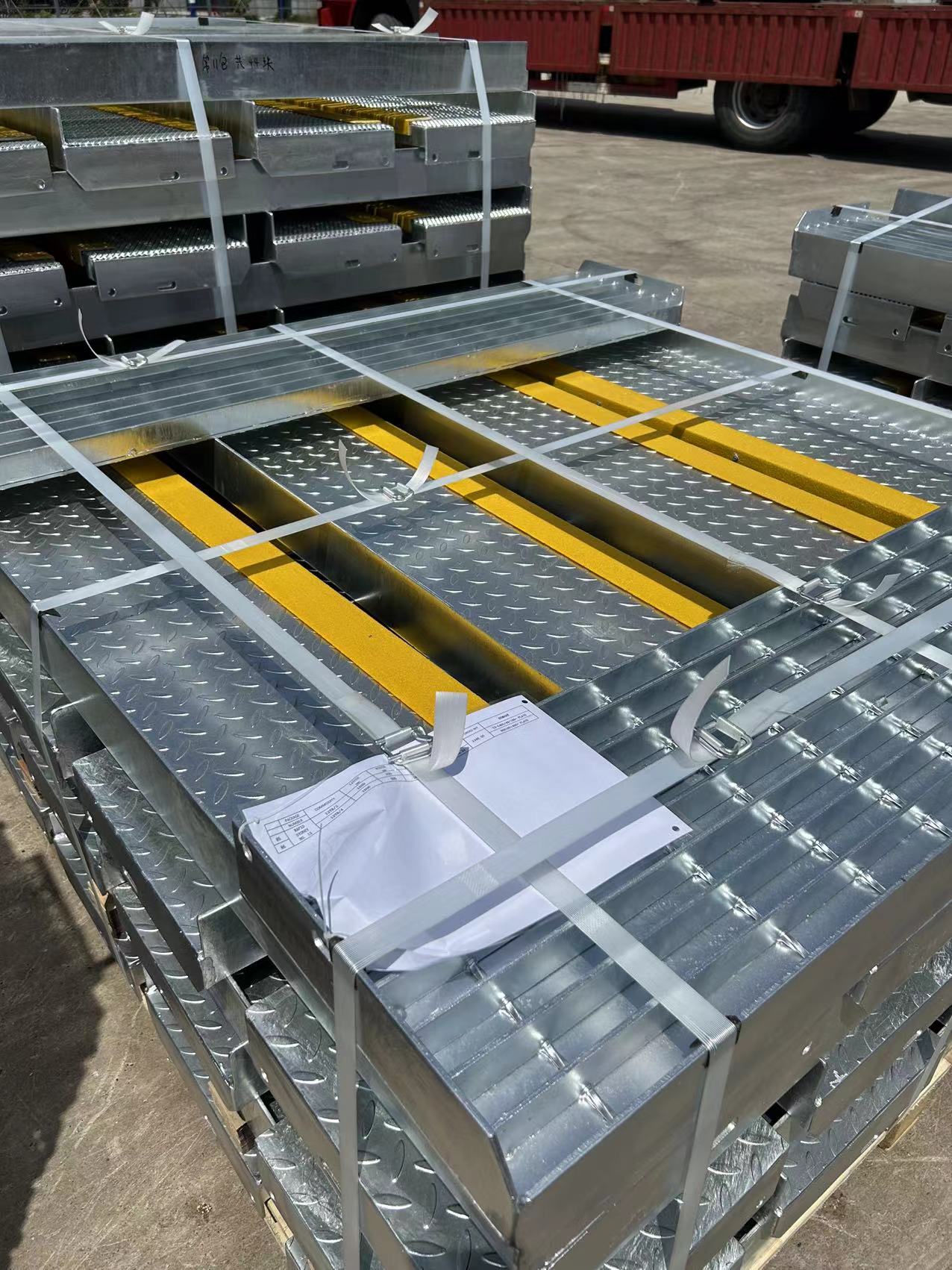
Custom steel grating can accommodate different panel dimensions, cutouts, edge treatments, angled sections, and other non-standard requirements. This is particularly useful for projects where the walkway needs to fit closely around existing equipment.
Consider Drainage Without Ignoring the Structure Below
One of the practical advantages of steel grating for walkways is its open surface. Rainwater and cleaning water can pass through the grating instead of remaining on top of a solid floor.
But the open surface is only part of the drainage solution. The structure underneath still needs to provide a suitable path for water. Drainage channels, trench covers, floor levels, and supporting steel should be coordinated so that water does not collect beneath the walkway.
This becomes especially important for outdoor platforms and industrial areas that are regularly washed down.
Connect Walkways With Stairs and Platforms Properly
An industrial access route often includes changes in elevation. A walkway may connect to a platform, lead to a staircase, or pass around equipment before reaching another operating area.
These transitions need to be coordinated during design. Differences in elevation, panel thickness, support levels, stair tread dimensions, and edge treatment can create unnecessary adjustment work if they are left until installation.
A complete access route may therefore include steel grating, stair treads, trench covers, handrails, toe boards, and fixing accessories. Coordinating these components helps maintain consistent dimensions and easier movement between different sections of the facility.
Choose a Fixing Method That Matches Maintenance Needs
The fixing method affects how easily the walkway can be inspected or modified later. Grating clips and clamps can allow panels to be removed when access to equipment below is required, while welded connections may be appropriate where permanent installation is preferred.
The choice should be based on the location of the walkway and the expected maintenance frequency. Areas above pumps, valves, cables, or other equipment may benefit from removable panels, while less frequently accessed sections may use a more permanent connection.
Thinking about maintenance before installation can prevent unnecessary cutting or dismantling later.
When Should a Walkway Be Customized?
Standard grating dimensions are suitable for many straightforward projects, but industrial facilities often contain details that make standard panels difficult to install efficiently.
Customization may be useful when the project involves:
- Irregular walkway shapes;
- Equipment or pipe openings;
- Different panel dimensions;
- Angled or curved edges;
- Special edge treatment;
- Connections with stairs or platforms;
- Specific installation or fixing requirements.
The purpose of customization is not simply to make the product different. It is to make the fabricated panels fit the actual project conditions and reduce unnecessary work at the installation site.
Steel Grating for Walkways From First Steel Grating
First Steel Grating provides steel grating products for industrial walkways, platforms, stairs, maintenance areas, drainage structures, and other access applications.
Its product range includes press-welded steel grating, press-lock grating, serrated grating, hot-dip galvanized grating, stair treads, trench covers, and fixing accessories. Customized panel sizes, openings, edge treatments, and irregular shapes can also be produced according to project requirements.
For projects with multiple access areas, coordinating grating panels, stairs, covers, and fixing components through one fabrication process can simplify installation and help maintain consistency across the project.
Conclusion
Choosing Steel Grating for Walkways should start with the actual conditions of the access route rather than with a standard product specification. Traffic requirements, grating type, support spacing, equipment openings, drainage, transitions, fixing methods, and customization all influence how well the finished walkway performs.
When these factors are considered before fabrication, steel grating can provide a practical and durable access solution for both indoor and outdoor industrial environments.
FAQ
1. What type of steel grating is commonly used for industrial walkways?
Press-welded steel grating is widely used for general industrial walkways. Serrated grating can be considered for areas where additional traction is needed because of water, oil, mud, or other surface contaminants.
2. Can steel grating walkways be customized around pipes and equipment?
Yes. Grating panels can be fabricated with different dimensions, openings, angled edges, and other modifications to fit around pipes, machinery, valves, columns, and other site conditions.
3. Is galvanized steel grating suitable for outdoor walkways?
Hot-dip galvanized steel grating is commonly used outdoors because its zinc coating provides corrosion protection for the steel. The appropriate treatment should still be selected according to the actual environment and expected service life.
4. Can steel grating walkway panels be removed for maintenance?
Yes. Depending on the project, grating clips or clamps can be used where removable panels are needed. This can be useful above equipment, cables, valves, and other areas requiring regular inspection.
Post time: Sep-29-2026