
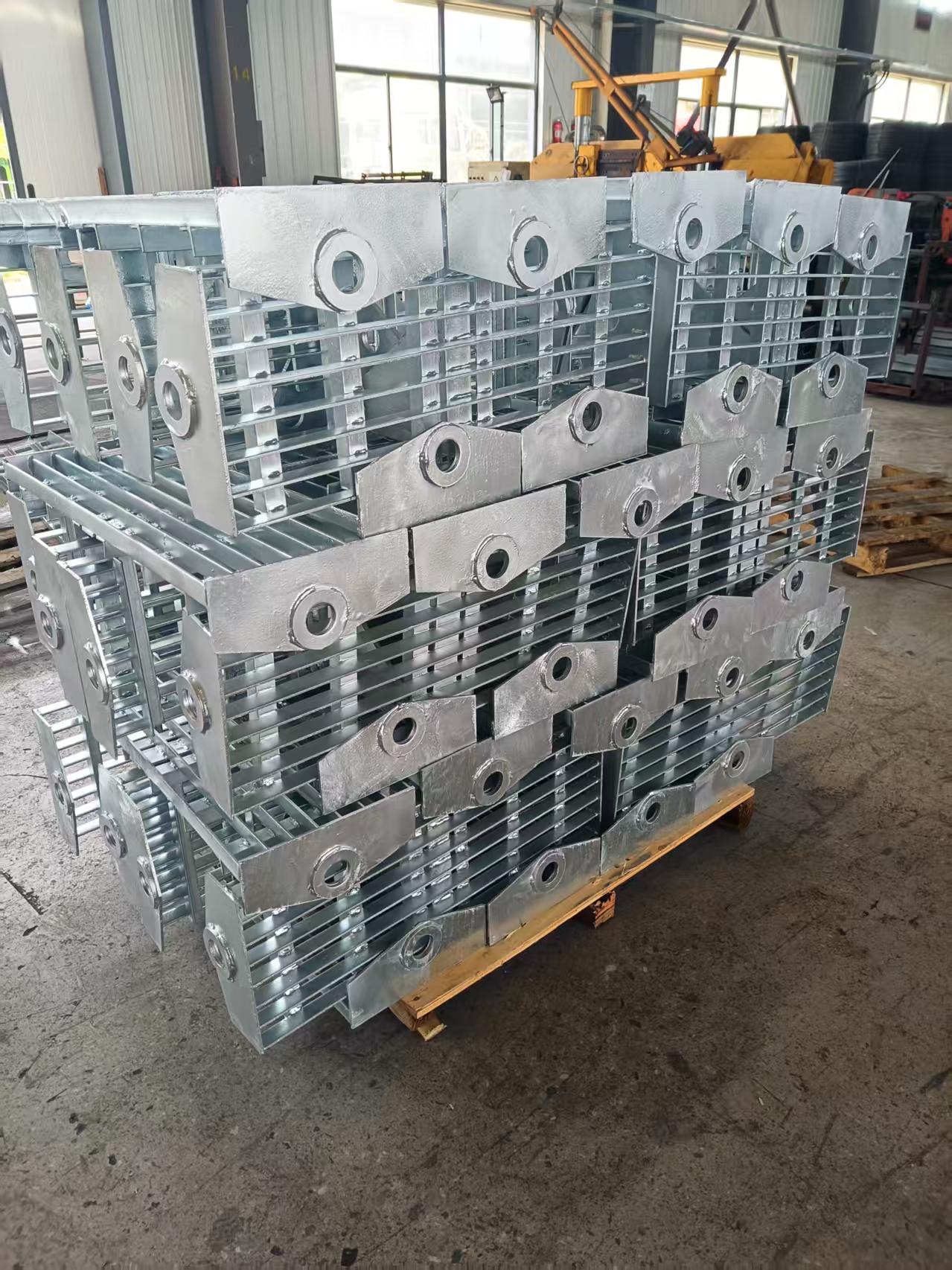
Rotating Stair Tread with Side Plates is designed for situations where a traditional straight stair system cannot easily fit the available space. In industrial facilities, platforms, equipment areas, and maintenance structures, access routes are often limited by pipelines, tanks, machinery, steel frames, and irregular layouts.
In these conditions, forcing a standard stair arrangement may reduce usable space or create unnecessary changes to the surrounding structure. A rotating stair tread provides more flexibility by allowing the stair direction or stepping position to adapt to the actual installation environment.
However, the value of a rotating stair tread is not only the ability to change direction. The design also needs to consider load transfer, installation accuracy, walking safety, connection strength, and long-term maintenance.
Why Do Industrial Projects Need Rotating Stair Treads?
A straight stair works well when there is enough horizontal space and a clear access path. However, many industrial structures are not designed around stair installation alone.
Access points are often located around:
- production equipment;
- storage tanks;
- pipe systems;
- elevated platforms;
- maintenance openings;
- compact steel structures.
In these areas, a fixed straight stair may create several problems:
| Installation Challenge | Limitation of Standard Straight Stairs |
|---|---|
| Limited space | Requires longer horizontal installation distance |
| Equipment interference | May conflict with pipes or machinery |
| Direction changes | Requires additional platforms or structures |
| Irregular layouts | Difficult to match existing steelwork |
| Maintenance access | May block surrounding working areas |
A rotating stair tread helps solve these problems by allowing the access route to better follow the available space.
The goal is not simply to make the stair smaller. It is to create a safer and more practical connection between different working levels.
Side Plates Provide More Than a Connection Point
The side plates on a Rotating Stair Tread with Side Plates may appear to be a simple fixing component, but they play an important role in installation and structural stability.
A well-designed side plate can help:
- connect the tread with supporting steel structures;
- maintain accurate tread positioning;
- simplify installation adjustment;
- improve load transfer between components;
- provide a cleaner connection appearance.
In industrial fabrication, small installation errors can accumulate quickly. If each tread position requires complex field adjustment, installation time increases and alignment becomes more difficult.Side plates provide a defined connection area, allowing the tread to work together with stair stringers, frames, or supporting structures.This is especially useful for customized access systems where the stair geometry needs to match existing equipment or platforms.
Rotating Design Requires Careful Consideration of Walking Safety
Changing the direction of a stair introduces different walking conditions compared with a straight stair.
On a straight stair, users naturally move forward with a consistent step rhythm. On a rotating stair section, the step width and walking line can change as the user moves through the turn.
Therefore, the design needs to consider:
- tread depth;
- step angle;
- walking direction;
- handrail position;
- available clearance;
- lighting conditions.
A rotating stair should not only fit into the available space. It should also allow users to move naturally and maintain stable footing.This is why rotating stair solutions are usually designed together with handrails, platforms, and surrounding structures rather than treated as independent stair components.
Load Performance Depends on the Complete Stair Structure
A stair tread does not carry load independently. The final performance depends on how the tread connects with the supporting structure.The load path normally includes:User load → Stair tread → Side plate connection → Supporting frame/stringer → Main structure
If one part of this system is weaker than the others, the overall stair performance can be affected.
Important factors include:
| Design Factor | Influence on Performance |
|---|---|
| Tread material | Determines basic strength and durability |
| Bearing bar size | Affects load resistance |
| Support spacing | Influences deflection |
| Side plate thickness | Affects connection stability |
| Fixing method | Determines installation reliability |
| Surrounding structure | Controls overall load transfer |
For this reason, selecting a tread only by appearance or size is not enough. The connection method and supporting structure should be considered at the same time.
Rotating Stair Treads Work Well in Customized Industrial Access Systems
Unlike standard building stairs, industrial access stairs often need to solve very specific problems.A maintenance route may need to pass around a large pipe. A platform may need access without interfering with equipment operation. A service stair may need to fit into an existing steel structure where the available installation area cannot be changed.In these cases, rotating stair treads can provide a practical solution.
Typical applications include:
- industrial maintenance platforms;
- equipment access stairs;
- steel structure platforms;
- production line service areas;
- power and energy facilities;
- chemical processing areas;
- outdoor machinery access.
The advantage is not only space saving. A properly designed rotating stair can improve the relationship between the access route and the surrounding working environment.
Anti-Slip Performance Still Matters in Rotating Stair Applications
Because industrial stairs are often used in outdoor or process environments, surface safety remains important.Water, oil, dust, and production residue can affect stair safety. A rotating stair section may require even more attention because users are changing direction while stepping.For these applications, options such as serrated steel grating treads can provide additional grip by improving contact between footwear and the tread surface.
However, anti-slip performance should work together with:
- proper drainage;
- suitable tread width;
- correct handrail placement;
- adequate lighting;
- regular cleaning.
A strong tread structure alone does not guarantee safe access if the overall stair layout does not support comfortable movement.
Integration With Steel Grating Platforms and Handrails
A rotating stair tread is usually only one part of a complete industrial access system.
To achieve reliable performance, the stair should be coordinated with:
- steel grating platforms;
- stair stringers;
- handrails;
- support frames;
- access openings;
- surrounding equipment.
For example, the position of the final tread affects where the handrail begins and ends. The stair angle affects platform clearance. The side plate design affects how easily the tread connects with the supporting frame.
When these components are designed separately, small differences can create installation problems. When they are considered together, the final access system becomes easier to install and maintain.
When Should You Consider a Rotating Stair Tread With Side Plates?
A rotating stair solution is especially useful when:
- the installation area is limited;
- equipment blocks a straight stair path;
- the access direction needs to change;
- existing steel structures cannot be modified significantly;
- maintenance personnel need a safer route between levels;
- standard stair components cannot match the site layout.
It is less about replacing all standard stairs and more about solving situations where standard geometry does not fit the actual project.
Customized Manufacturing Improves Installation Results
Industrial projects often have different requirements for tread dimensions, connection details, angles, and support structures.
A Rotating Stair Tread with Side Plates can be customized according to:
- tread size;
- steel grating type;
- bearing bar specification;
- side plate dimensions;
- connection method;
- surface treatment;
- overall stair layout.
Combined with steel grating platforms, handrails, and supporting structures, customized fabrication helps create a complete access solution rather than a collection of separate components.
Conclusion
A Rotating Stair Tread with Side Plates provides flexibility for industrial access systems where standard straight stairs cannot easily match the available space.
Its value is not only the ability to change stair direction. A successful design must also consider connection strength, load transfer, walking safety, installation accuracy, and coordination with surrounding structures.
By combining suitable tread design, side plate connections, anti-slip surfaces, and supporting steel structures, rotating stair systems can provide safer and more efficient access for complex industrial environments.
FAQ
1. Where are Rotating Stair Treads with Side Plates commonly used?
They are commonly used in industrial platforms, equipment access areas, steel structures, maintenance systems, and locations where space limitations make standard stairs difficult to install.
2. What is the purpose of side plates on stair treads?
Side plates provide a stronger and more accurate connection between the tread and supporting structures. They help with installation positioning and improve overall stability.
3. Are rotating stair treads suitable for heavy industrial environments?
Yes. When designed with suitable materials, bearing bars, supports, and connection details, they can be used in demanding industrial access applications.
4. Can rotating stair treads be customized?
Yes. Dimensions, tread structure, side plates, connection methods, and surface treatments can be adjusted according to project requirements.
Post time: Sep-03-2026