
Industrial facilities often contain dense networks of pipes, cables, support frames, and mechanical equipment. These installations create complicated spatial conditions, especially in areas where workers need safe access for inspection, operation, and maintenance. Standard rectangular grating panels may not always fit these spaces efficiently. Cutting openings on-site or using multiple small panels can also increase installation work and create unnecessary joints.
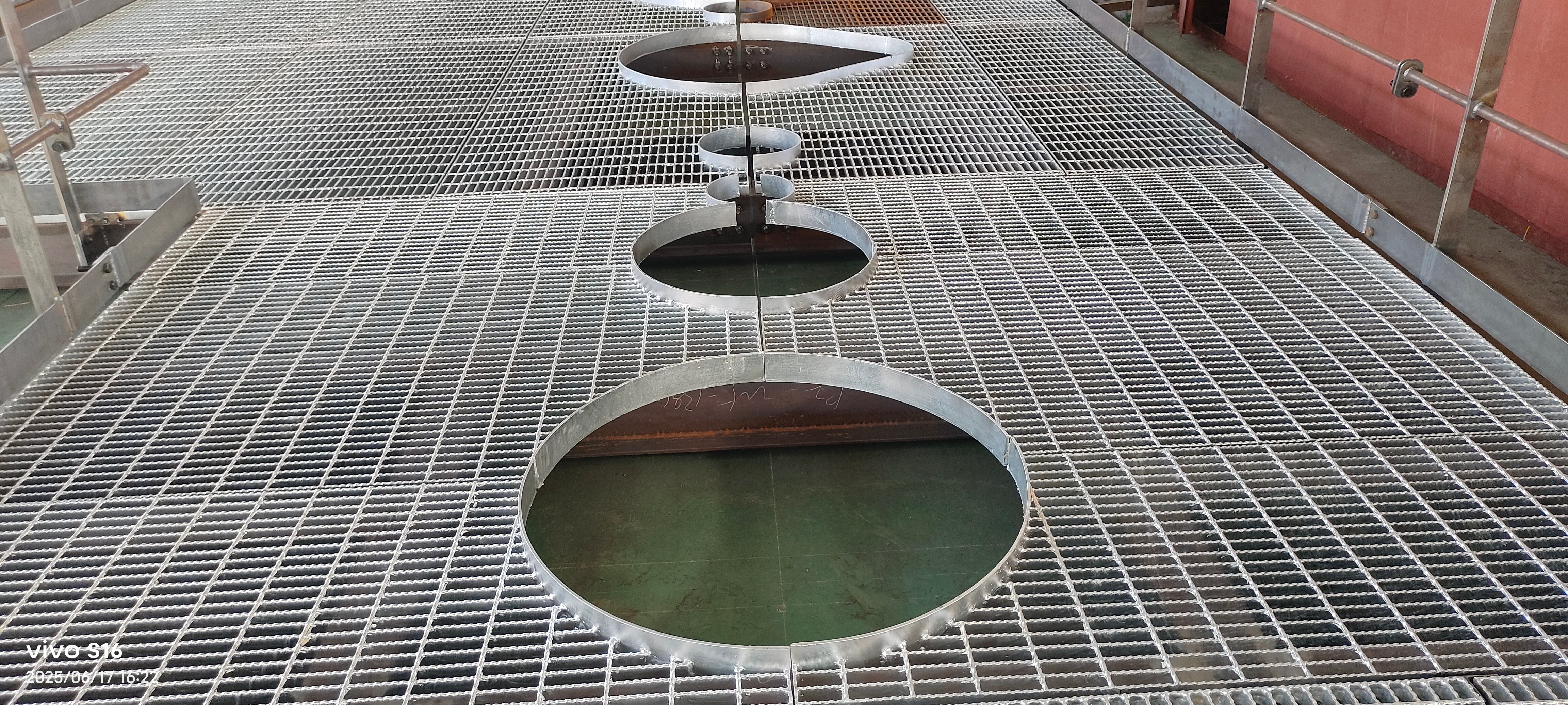
Profiled Steel Grid offers a practical approach to these challenges by allowing the grating layout to accommodate different structural shapes and installation requirements. Through suitable panel profiles, dimensions, and opening arrangements, it can help create accessible working surfaces around industrial infrastructure without treating every obstacle as a reason to redesign the entire platform.
Working Around Pipes and Fixed Pipeline Systems
Pipelines frequently pass through industrial platforms, walkways, and elevated service areas. Their positions may be determined by existing equipment connections, drainage requirements, or process layouts. As a result, the surrounding floor structure must often accommodate pipes that cannot easily be relocated. A conventional grating panel may need to be cut around these installations. However, irregular cutting can reduce the effective bearing area and leave gaps that require additional treatment. If several pipes pass through the same section, the resulting layout can become difficult to install and maintain.
A properly designed Profiled Steel Grid can be configured to suit the required platform outline and pipe locations. Instead of relying entirely on adjustments during construction, the panel dimensions and edge shapes can be planned according to measured site conditions.
Several details deserve attention when designing grating around pipelines:
- Pipe clearance: The opening should provide sufficient space for the pipe, insulation, movement, and any required maintenance access. The necessary clearance depends on the pipe system and operating conditions.
- Panel support: Cutouts and irregular edges should not compromise the required bearing support. Additional framing may be necessary around larger openings.
- Access for inspection: Workers should be able to reach relevant valves, joints, and inspection points without removing excessive sections of the platform.
- Future modifications: Where pipeline routes may change, the platform layout should consider whether individual panels can be removed or replaced without disturbing adjacent structures.
The objective is not simply to make the grating fit around a pipe. It is to maintain a functional walking surface while preserving access to the pipeline system.
Maintaining Cable Access Without Disrupting the Platform
Cable trays and electrical conduits introduce another common challenge. They may run beneath walkways, cross between equipment areas, or follow the edges of elevated platforms. Their locations can change as facilities add instruments, control systems, or auxiliary equipment.
If grating panels completely cover cable routes, maintenance personnel may need to remove large sections to inspect or replace cables. On the other hand, oversized openings can create unnecessary gaps and reduce the usable walking area.
The design of Profiled Steel Grid should therefore consider both the cable arrangement and the expected maintenance method. In some applications, a removable panel or a designated access section may be more practical than a permanently fixed layout.
Cable access also requires coordination with other installation requirements. Electrical separation, cable protection, ventilation, and protection from falling objects may influence the final arrangement. These considerations should be reviewed with the electrical and structural design teams rather than determined by the grating layout alone.
For facilities with frequently updated cable systems, modular panel arrangements can make future maintenance more manageable. A clearly defined access section allows workers to reach cable trays without dismantling a large part of the platform. It also helps maintenance teams identify which panels can be safely removed and which areas must remain fixed.
Creating Usable Space Around Industrial Equipment
Pumps, compressors, motors, tanks, and production machinery often occupy irregular spaces. Their foundations, connecting pipes, service connections, and moving parts can limit the available platform area. Workers may need to approach equipment from several directions, even when the surrounding space is restricted. In these conditions, the grating layout should follow the actual equipment arrangement instead of relying on a standard panel shape wherever possible.
A Profiled Steel Grid can help accommodate equipment foundations, access routes, and platform boundaries through appropriately shaped panels. This is particularly useful when the walking surface needs to extend around machinery while maintaining access to inspection points and operating components.
However, the design must distinguish between ordinary walking areas and locations that require special structural consideration. Heavy equipment foundations, vibration zones, and areas exposed to concentrated loads may need separate support arrangements. Grating panels should not be expected to compensate for insufficient structural framing.
Equipment access should also account for the way maintenance is performed. Some components require frequent visual inspection, while others need space for tools, lifting equipment, or partial removal. A platform that provides enough room for normal operation may still be inconvenient during major maintenance. Before finalizing the layout, designers should identify the equipment that requires regular access and determine whether the corresponding grating sections need to be removable.
Coordinating Panel Shapes With Structural Supports
Irregular grating layouts require careful coordination between panel geometry and the supporting structure. A panel may fit the visible outline of a platform but still be unsuitable if its edges do not align with adequate support points.
This issue becomes more important when openings are created around multiple pipes, cable trays, or equipment foundations. Excessive cutting can divide a panel into narrow sections, complicate installation, and create unsupported edges.
The design of Profiled Steel Grid should begin with accurate site measurements and a clear understanding of the platform framing. Important considerations include the direction of the bearing bars, support spacing, panel dimensions, opening positions, and fastening locations.
- Confirm the support arrangement: Determine where the panel edges and cutout boundaries will be supported before finalizing the profile.
- Avoid unnecessarily narrow sections: Panel shapes should retain practical dimensions for handling, installation, and maintenance.
- Coordinate openings with other systems: Pipe routes, cable trays, equipment foundations, and access requirements should be reviewed together.
- Plan panel identification: Where several customized panels are used, clear identification can reduce installation errors and simplify future replacement.
Installation and Maintenance in Restricted Areas
Industrial platforms are not always easy to access during construction. Some are located above operating machinery, inside production buildings, or within spaces with limited lifting access. Large, irregularly shaped panels may be difficult to transport and position, even when their dimensions are correct.
For this reason, panel size and installation sequence should be considered together. Dividing a complicated platform into manageable sections may simplify handling, but excessive segmentation can increase the number of joints and fasteners. The best arrangement balances installation convenience with structural requirements and long-term accessibility.
Maintenance considerations should also influence the final panel layout. Sections surrounding frequently serviced valves, cable connections, or equipment components may benefit from removable designs. At the same time, removable panels need suitable fixing arrangements to prevent movement during normal use.
Routine inspections should focus on fastening conditions, damaged bearing bars, corrosion, deformation, and areas where debris accumulates around equipment. If a panel is repeatedly removed for maintenance, its edges and fixing points should receive particular attention.
Selecting Profiled Steel Grid for Complex Industrial Layouts
For projects involving dense pipelines, cable systems, and machinery, the value of customized grating lies in how well it fits the overall installation. The panel profile, opening positions, support arrangement, and maintenance access should be considered as part of one coordinated design.
A suitable Profiled Steel Grid solution can help reduce unnecessary on-site cutting, improve access to surrounding infrastructure, and make platform sections easier to organize. When reviewing customized grating requirements, accurate drawings, site measurements, loading conditions, and installation constraints provide a more reliable basis for determining the appropriate configuration.
Conclusion
Industrial platforms must provide more than a continuous walking surface. They also need to accommodate pipes, cables, equipment, and the maintenance activities associated with them. By coordinating panel shapes with structural supports and access requirements, Profiled Steel Grid can help create more practical layouts for complex industrial environments. Careful planning before production and installation is essential to achieving a safe, accessible, and maintainable platform.
FAQs
1. Can profiled steel grid panels be designed around multiple pipe openings?
Yes. Panel outlines and opening positions can be customized according to project drawings and site measurements. Larger or irregular openings may require additional supporting frames.
2. Are removable grating panels suitable for cable maintenance areas?
They can be useful where workers need repeated access to cable trays or connections. The fixing arrangement must prevent unintended movement while allowing authorized removal.
3. What information is needed before producing customized profiled grating?
Common requirements include platform dimensions, support locations, loading conditions, pipe and cable positions, opening sizes, and installation constraints. Detailed drawings help reduce measurement errors.
4. Does a customized panel automatically provide higher load capacity?
No. Panel shape alone does not determine load capacity. Bearing bar dimensions, material, span, support conditions, and loading requirements must all be considered in the structural design.
Post time: Nov-04-2026