
Press-Welded Steel Grating Supplier selection becomes especially important when a project involves hundreds or even thousands of grating panels. In a small installation, one slightly different panel may be adjusted on site. In a large industrial platform, however, repeated dimensional differences, inconsistent bar spacing, or uneven panel geometry can turn into a much larger installation problem.
This is why large steel grating projects should not be judged only by whether each individual panel looks acceptable. What matters is whether the entire batch works together as one system. For industrial platforms, power plants, processing facilities, wastewater projects, walkways, and equipment access structures, consistent fabrication can save considerable installation time and reduce unnecessary field modification.
A reliable press-welded steel grating supplier therefore needs to think beyond individual panels and maintain stable production across the whole project.
Why Does Consistency Matter More as Project Size Increases?
Press-welded steel grating is produced by combining bearing bars and cross bars into a rigid grid structure. On a small platform, a minor dimensional difference may not immediately cause trouble. Once the number of panels increases, however, small variations begin to accumulate.
For example, if one panel is slightly wider than intended, it may affect the next panel. If several panels have inconsistent dimensions, the final row may no longer fit the available space. The same problem can occur with openings, stair connections, equipment areas, and platform edges.
Large projects therefore depend heavily on repeatability. The real value of consistent production is that installers can move from one area to another without repeatedly checking whether each panel needs additional cutting or adjustment.
For project owners and contractors, this can mean fewer interruptions during installation and a more predictable construction schedule.
A Large Platform Is a Series of Repeated Connections
Industrial steel grating platforms often look simple from a distance, but they are actually made up of many repeated interfaces. Each panel needs to sit correctly on the support structure, align with adjacent panels, and leave the intended gap around surrounding steelwork.
This makes dimensional consistency important in several areas:
- Panel length and width;
- Squareness of the panel;
- Bearing bar spacing;
- Cross bar alignment;
- Edge bar position;
- Relationship between repeated panel sizes.
If one panel differs slightly, the effect may remain local. If the same variation continues through an entire production batch, the installation problem can spread across a much larger area.
This is especially relevant for press-welded steel grating for industrial platforms, where repeated panel modules are often used to cover large structural areas.
Uniform Bar Spacing Affects More Than Appearance
Bearing bar and cross bar spacing are usually discussed in relation to load capacity and open area, but consistency also affects installation quality and the overall appearance of a completed platform.
When adjacent panels are installed together, irregular spacing can make joints visually obvious. More importantly, inconsistent bearing bar positions may complicate connections around frames, openings, or other structural details.
For large industrial facilities, this becomes more noticeable because dozens of panels may be installed in the same line. Maintaining stable spacing across the production batch helps the finished platform look and function like a coordinated system rather than a collection of unrelated panels.
For a press welded bar grating manufacturer, maintaining repeatability during production is therefore just as important as producing one correct sample.
Welding Quality Needs to Remain Stable Across the Entire Batch
The strength of press-welded grating depends on the relationship between the bearing bars and cross bars. In large projects, the challenge is not simply achieving a strong weld on one panel, but maintaining stable welding quality throughout repeated production.
Industrial projects may include hundreds of panels manufactured over several production runs. If welding conditions vary significantly between batches, the finished grating may show differences in rigidity, appearance, or deformation.
Stable production control helps maintain a more uniform product from the first panel to the last. This becomes particularly important when the same platform is installed in phases or when additional panels are supplied later for project expansion.
Consistency also has value for future replacement. If a damaged panel needs to be replaced years later, clear drawings and controlled panel specifications make it easier to reproduce the required structure.
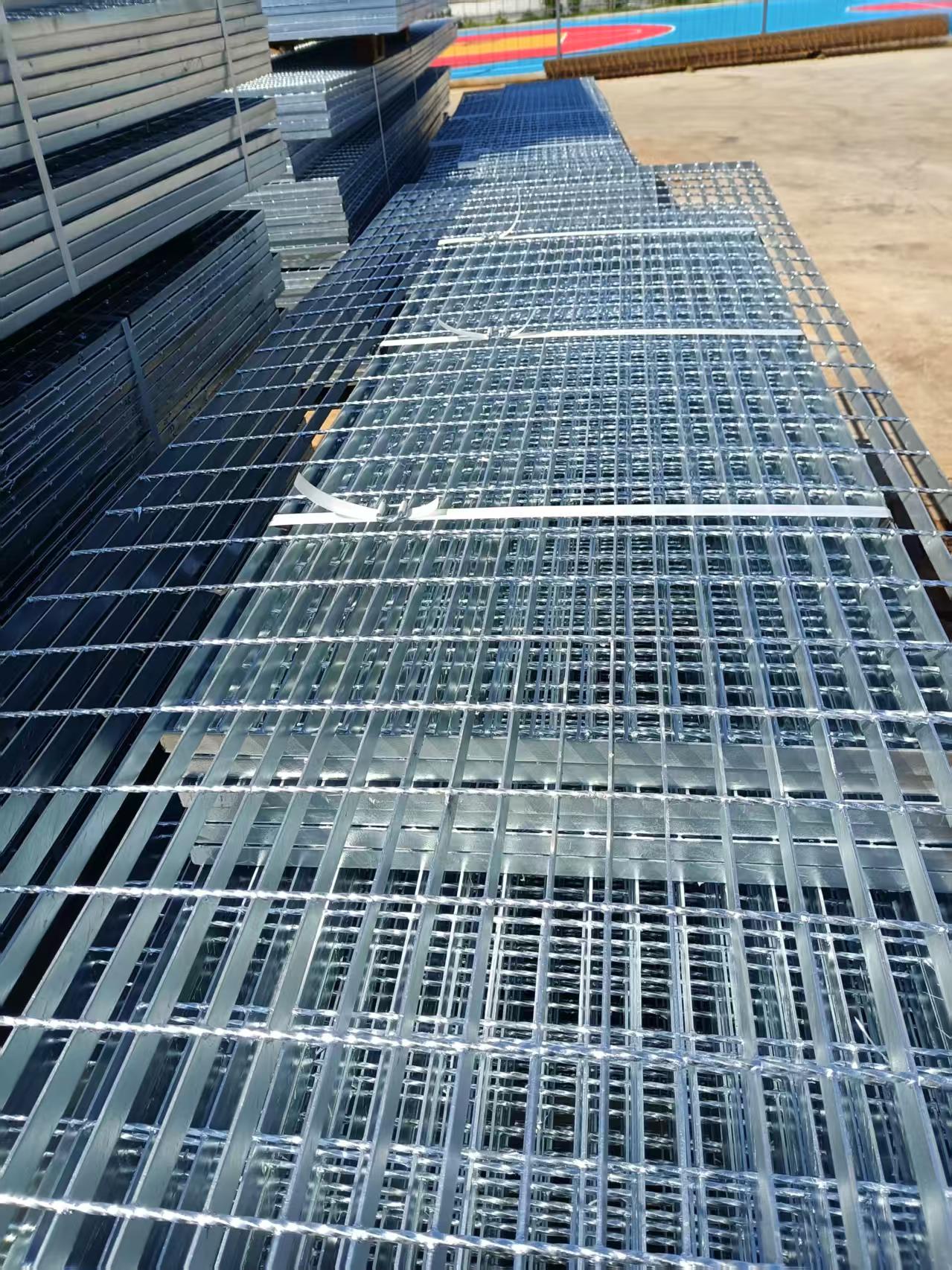
Why Can Hot-Dip Galvanizing Reveal Fabrication Problems?
Many press-welded steel grating projects use hot-dip galvanizing for corrosion protection, particularly in outdoor, wastewater, energy, and industrial processing environments.
Galvanizing itself is not the only concern. Fabrication quality before galvanizing can influence the final panel condition. Welding stress, uneven geometry, and poorly controlled panel dimensions may become more noticeable after thermal processing.
This is why accurate fabrication before galvanizing matters. A panel should already have the correct geometry, openings, edge treatment, and welded structure before entering the galvanizing stage.
For large projects, controlling panel shape and dimensions before surface treatment helps reduce problems such as excessive adjustment during installation. The goal is not simply to produce galvanized grating, but to deliver panels that still fit the project after all fabrication and finishing processes are complete.
Repeated Panel Sizes Can Improve Project Efficiency
Many industrial platforms contain repeated structural bays. Instead of treating every panel as an independent custom item, these repeated areas can often be organized into a limited number of panel types.
This has several advantages. Production becomes easier to control, installation becomes more predictable, and replacement panels can be identified more clearly in the future.
For example, a large platform may include a group of standard repeated panels, several edge panels, a few opening panels, and several removable maintenance sections. Organizing the project around these panel families can make fabrication and installation more efficient.
A capable custom press-welded steel grating supplier can work from project drawings to identify repeated dimensions while still accommodating special areas around equipment, pipes, stairs, or structural columns.
Panel Identification Becomes Valuable on Large Projects
When a project contains only a few steel grating panels, installers can usually identify their positions visually. On a large industrial platform, that approach quickly becomes inefficient.
Panels with similar dimensions may belong to different locations because of openings, edge conditions, or support arrangements. If they are mixed during unloading or installation, workers may spend unnecessary time comparing dimensions and finding the correct position.
Clear panel identification can make the installation process much easier. Panel marks can correspond with layout drawings so that installation teams can find the correct location without repeatedly measuring every component.
This is particularly useful for large export projects, where the manufacturer and installation team may be located in different countries. Good identification reduces dependence on on-site interpretation and helps the delivered product follow the intended layout.
Consistency Also Helps With Future Maintenance and Expansion
Industrial facilities rarely remain unchanged forever. Equipment may be replaced, maintenance areas may be modified, or a platform may be extended as production capacity grows.
When the original grating system has clear dimensions and consistent fabrication standards, future changes become easier to manage. Replacement panels can be matched more accurately, and extensions can follow the same structural logic as the existing platform.
This long-term value is often overlooked during the first project stage. A steel grating platform is not only something that needs to fit during initial installation; it may need to remain serviceable for many years.
For this reason, working with an experienced press-welded steel grating manufacturer can be valuable when a project is expected to require future maintenance, replacement, or expansion.
How First Steel Grating Supports Large Press-Welded Grating Projects
First Steel Grating provides press-welded steel grating and related customized solutions for industrial platforms, walkways, stairs, drainage areas, and steel structure projects.
For large or repeat-order projects, the focus is not only on producing individual panels but also on maintaining coordination across the complete order. Depending on project requirements, First Steel Grating can support customized panel dimensions, repeated panel types, special openings, edge treatment, hot-dip galvanized finishing, serrated surfaces, stair treads, trench covers, and related fixing components.
For projects based on engineering drawings, panel types and special sections can be coordinated before production so that standard areas, edge panels, opening panels, and removable sections are easier to distinguish and install.
This approach is especially useful for industrial platforms where a large number of panels need to work together with the same support structure.
From One Sample Panel to a Complete Project
A sample panel can show basic fabrication quality, but a large project requires something more: repeatability.
The real test of a Press-Welded Steel Grating Supplier is whether hundreds of panels can maintain consistent dimensions, spacing, fabrication quality, and project identification from one production batch to the next.
For industrial platforms, processing facilities, wastewater plants, energy projects, and other large access systems, this consistency can reduce installation problems and make future maintenance easier.
If you are planning a large press-welded steel grating project, you can send First Steel Grating your platform layout or project drawing. Our team can review repeated panel areas, special openings, removable sections, surface requirements, and related grating components to develop a coordinated fabrication solution for the complete project.
FAQ
1. Why is panel consistency important for large press-welded steel grating projects?
Large projects use many adjacent panels, so small dimensional differences can accumulate across the platform. Consistent panel dimensions and spacing help improve installation efficiency and reduce unnecessary field adjustment.
2. Can press-welded steel grating be produced in repeated panel sizes?
Yes. Large platforms can often be divided into repeated standard panels together with special edge, opening, and removable panels, which can improve both production and installation efficiency.
3. Can press-welded steel grating be hot-dip galvanized?
Yes. Hot-dip galvanized press-welded steel grating is commonly used for outdoor and industrial environments where corrosion protection is required.
4. Can First Steel Grating produce press-welded grating according to project drawings?
Yes. First Steel Grating can produce customized press-welded grating based on project drawings, including different panel dimensions, openings, edge details, serrated surfaces, stair treads, trench covers, and related components.
Post time: Sep-18-2026