
Municipal Drainage Grating is often judged by one visible feature: how much open area the grating provides. In real streets, however, drainage performance depends on much more than the size of the openings.
Rainwater first has to reach the grating, pass through it, enter the drainage channel, and continue into the underground system. At the same time, the surface must remain suitable for pedestrians, bicycles, cleaning equipment, parked vehicles, or road traffic.
This means a municipal drainage grating can have a large theoretical open area and still perform poorly if leaves block the inlet, the frame sits too low, sediment accumulates underneath, or the grating is difficult to remove for cleaning.
A more useful way to evaluate drainage grating is to look at the complete path from street surface to drainage channel, not at the grating panel alone.
Where Municipal Drainage Performance Is Usually Lost
| Drainage Stage | Typical Problem | Result on Site |
|---|---|---|
| Water approaching the inlet | Poor pavement slope or local depression | Water bypasses the grating or forms puddles |
| Grating surface | Leaves, litter, or sediment cover openings | Effective inlet area decreases |
| Grating-to-frame connection | Uneven installation or damaged frame | Noise, movement, or unsafe surface |
| Drainage channel | Sediment accumulates below the opening | Water passes the grating but drains slowly |
| Maintenance stage | Panels are too heavy or difficult to remove | Cleaning becomes less frequent |
This distinction matters because replacing the grating with a larger or heavier model may not improve drainage if the real restriction is somewhere else in the system.
A Large Open Area Does Not Guarantee Better Street Drainage
The open area of a Municipal Drainage Grating affects how quickly water can enter the channel, but the usable opening can change dramatically during a storm.
Leaves, plastic bags, road sediment, branches, and other debris can cover part of the surface. A grating that performs well in clean conditions may lose a significant portion of its effective inlet area once debris begins to accumulate.
This is especially important in:
- tree-lined streets;
- low points where sediment gathers;
- markets and high-litter areas;
- roads with heavy runoff;
- locations where cleaning intervals are long.
For these streets, drainage design should not assume that the full nominal open area remains available at all times.
The shape and orientation of the openings also affect how debris behaves. Very narrow openings may reduce the entry of larger objects but can become blocked more easily by leaves and sediment. Very large openings improve water entry but may create problems for pedestrians or small wheels.
The useful design goal is therefore not maximum opening size, but reliable drainage under realistic street conditions.
Pedestrian Areas and Roadways Should Not Use the Same Logic
Municipal drainage systems operate across many different public spaces. A grating beside a pedestrian plaza does not experience the same loading or surface interaction as a grating installed along a road.In pedestrian areas, the opening arrangement should support comfortable walking and reduce the chance that narrow heels, walking aids, bicycle tires, or small wheels interact poorly with the surface.
Roadside and traffic areas introduce different concerns. Vehicle wheels create concentrated loads, and repeated traffic can produce much more demanding conditions around the grating frame.This makes the location of the grating just as important as its nominal load capacity.
A simple distinction is useful:
Pedestrian drainage areas prioritize walking safety, opening geometry, slip resistance, and convenient maintenance.
Vehicle drainage areas require greater attention to wheel loads, frame support, impact, repeated traffic, and long-term stability.
Using a road-level heavy-duty structure everywhere may be unnecessary, while using a pedestrian grating in a wheel-load area can create a serious mismatch.
The Frame Often Determines Whether the Grating Stays Stable
Municipal drainage grating rarely fails as an isolated panel. The surrounding frame and supporting structure strongly influence how the system performs.
A grating panel may have sufficient strength, but if the frame is distorted, poorly supported, or no longer level with the road surface, movement can develop under repeated traffic.
This can lead to:
- rattling under vehicle loads;
- local movement or rocking;
- uneven walking surfaces;
- accelerated wear around contact points;
- damage to surrounding pavement.
For road and parking applications, the load should therefore be transferred through both the grating and the supporting frame.
A heavier Heavy Duty Steel Grating is useful only when the frame beneath it is capable of supporting the same loading condition.
This is particularly important where wheel loads repeatedly pass near the edge of the panel rather than through the center.
Water Can Pass Through the Grating and Still Have Nowhere to Go
It is easy to focus on whether water can enter through the grating, but the drainage channel underneath must also remain clear.
Sediment can accumulate below roadside gratings, especially where stormwater carries sand, soil, leaves, or road dust. Over time, this reduces the useful depth of the channel and may slow the flow even when the grating openings remain unobstructed.
This creates a common situation: the surface grating appears clean, but standing water still develops during heavy rainfall.
The restriction is no longer the inlet—it is the channel below.
For municipal drainage systems, maintenance access is therefore part of hydraulic performance. A drainage cover that cannot be removed easily makes routine sediment removal more difficult, which can gradually reduce system performance.
This is one reason panel size matters. A very large grating may reduce joints, but it can become too heavy for practical manual removal. Smaller removable sections may be more suitable in locations that require regular cleaning.
Street Cleaning Should Influence the Grating Layout
A municipal drainage system may operate for years, so it should be designed around how it will actually be cleaned.
A technically efficient grating can become a maintenance problem if crews need special lifting equipment every time sediment must be removed. On the other hand, too many small panels can increase joints, fasteners, and possible movement points.
The best panel division depends on cleaning frequency, channel width, expected debris load, and whether pedestrian or vehicle traffic passes over the grating.
In areas with frequent sediment accumulation, easy access to the channel can be more valuable than increasing the open area of the grating itself.
This is an important practical distinction: long-term drainage depends on cleanable capacity, not just designed capacity.
Anti-Slip Performance Matters Around Wet Drainage Areas
Drainage grating is intentionally installed where water is expected, so the surrounding surface is often wet during or after rainfall.
Open-grid construction allows water to leave the surface quickly, but pedestrians may still encounter mud, road residue, or other contamination on the bearing bars.
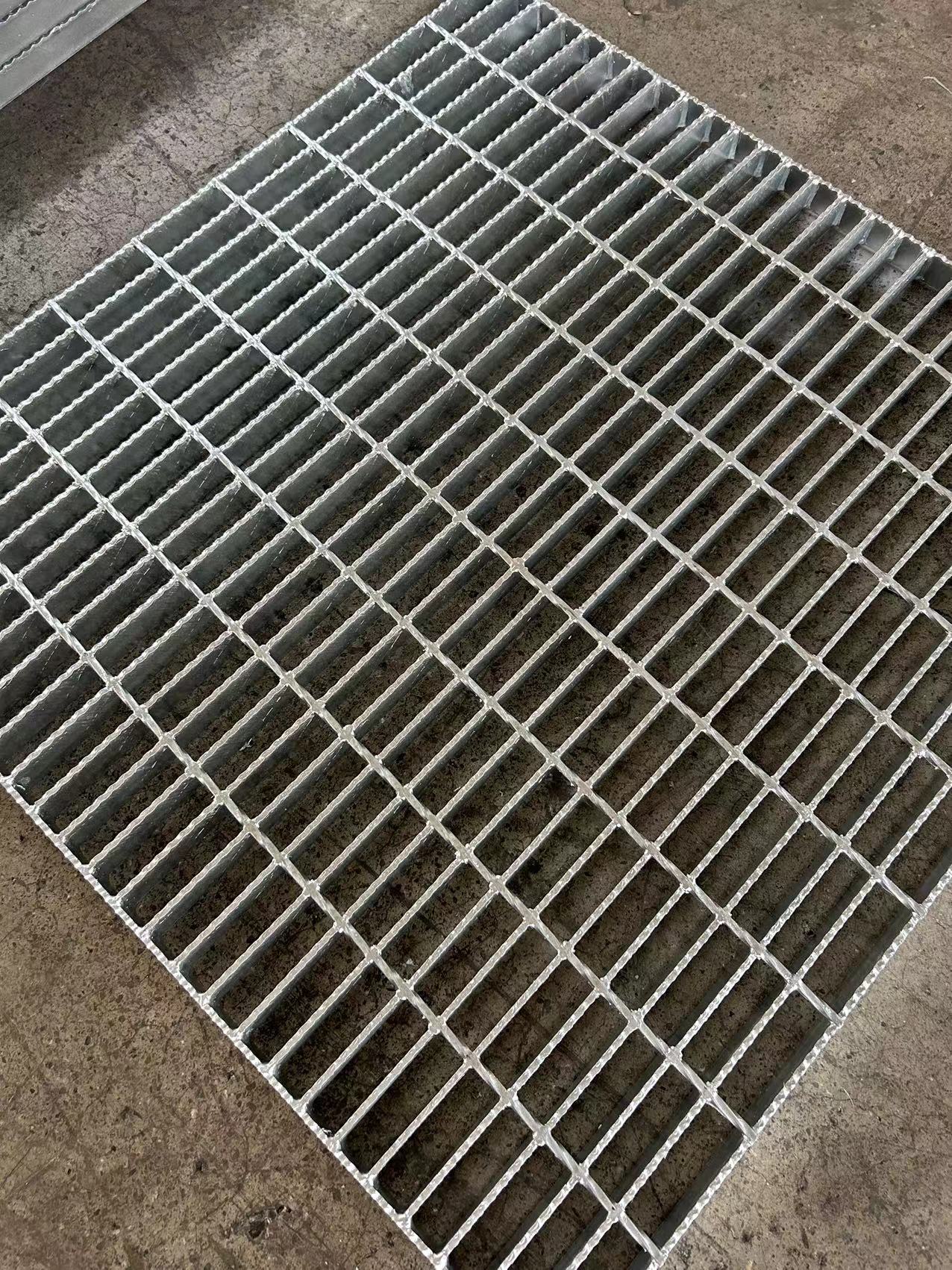
For locations with frequent foot traffic, Serrated Steel Grating can provide additional grip. This can be useful near pedestrian crossings, service areas, sidewalks, or maintenance zones.
Slip resistance should be matched to the actual use of the area rather than added automatically to every drainage location. In a roadway-only zone, structural load may dominate the design; in a pedestrian zone, surface interaction becomes much more important.
Different Municipal Locations Need Different Drainage Grating Solutions
A city rarely needs one universal grating specification.
Sidewalks, roadside drainage channels, parking areas, public squares, industrial streets, and service roads all combine different load and maintenance conditions. Some areas need convenient removable covers, while others need higher structural capacity or better surface grip.
Depending on the location, municipal drainage systems may use standard steel grating, serrated grating, heavy-duty steel grating, trench covers, custom-sized panels, or steel frames designed around the drainage channel.
Panel size, bearing bar specification, opening arrangement, surface treatment, edge finishing, and support frame can be matched to the street environment and expected load.
The objective is to make the drainage system reliable under real operating conditions, rather than simply maximize the amount of open space in the surface.
Conclusion
Municipal Drainage Grating should be evaluated as part of the entire street drainage system.
Water must reach the inlet, pass through the grating, continue through the channel, and still be manageable after leaves, sediment, traffic, and years of maintenance have changed the original conditions.
The most useful design decisions therefore balance drainage capacity, debris behavior, pedestrian safety, wheel loads, frame support, and cleaning access.
A grating that can be cleaned easily and remains stable under its actual traffic condition may provide better long-term drainage performance than one selected only for a larger theoretical open area.
FAQ
1. Does a larger open area always improve Municipal Drainage Grating performance?
Not always. Leaves, sediment, and litter can reduce effective opening area, while very large openings may create problems for pedestrians or small wheels. Practical drainage depends on both open area and real street conditions.
2. Can the same drainage grating be used for sidewalks and roads?
Not necessarily. Pedestrian areas focus more on walking safety and opening geometry, while road applications must consider wheel loads, repeated traffic, and frame strength.
3. Why can water remain on the road even when the grating is clear?
The drainage channel underneath may contain sediment or other restrictions. Water can pass through the grating but still drain slowly if the downstream flow path is blocked.
4. Why are removable grating panels important in municipal drainage systems?
They provide access for removing sediment, leaves, and debris from the drainage channel. Easier maintenance helps preserve the drainage capacity of the system over time.
Post time: Aug-21-2026