
Hot-Dip Galvanized Handrail Termination may look like a small detail at the end of a railing system, but it is actually related to pedestrian access, corrosion protection, welding, drainage, installation, and connections with surrounding steel structures. Straight railing sections can usually be fabricated repeatedly according to standard dimensions, while the termination often needs to change according to the position of stairs, platforms, equipment, walls, or access openings. This is why the end detail is often more complicated than the straight section itself.
On industrial platforms, steel grating walkways, stairs, municipal facilities, and equipment maintenance areas, a poorly planned Hot-Dip Galvanized Handrail Termination may lead to projecting ends, internal water entry, corrosion around welds, repeated field cutting, or interference with removable grating panels and maintenance access. For this reason, handrail termination should not be treated as a final detail added after fabrication. It should be considered as part of the complete railing and access system from the beginning.
Why Is Hot-Dip Galvanized Handrail Termination More Complicated Than a Straight Railing Section?
Straight railing usually has a high degree of repetition. Posts are arranged at regular intervals, horizontal rails continue in the same direction, and most welds and connections follow a similar pattern. At the end of a railing, however, the surrounding conditions often change. The termination may be located at a platform edge, stair entrance, wall connection, or equipment maintenance area, so the available space and connection requirements become more complex.
Common handrail termination arrangements may include:
- returning the rail toward a post;
- connecting the handrail to a wall or steel frame;
- changing direction at a stair landing;
- ending at the edge of a steel grating platform;
- avoiding equipment, piping, or access doors;
- transitioning into another railing direction or corner.
In other words, the final section of the railing is often the point where a standardized railing system meets the actual site layout. If this area is not resolved during the drawing stage, installers may need to cut, re-weld, or add extra connection pieces on site. These secondary modifications can affect coating continuity, corrosion resistance, and the appearance of the finished structure.
Hollow Handrails Also Require Attention to Water Entry and Drainage
Many industrial handrails are fabricated from round tube, square tube, or other hollow sections. This means termination design is not simply a matter of closing the end. Rainwater, washdown water, and condensation can all enter hollow members. If moisture remains trapped inside for long periods, internal corrosion can develop in areas that are difficult to inspect or maintain.
Different environments create different concerns:
| Service Environment | Main Termination Concern |
|---|---|
| General outdoor platform | Rainwater entry and repeated wet-dry cycles |
| Wastewater treatment area | High humidity, wastewater, and corrosive gases |
| Coastal facility | Salt spray and chloride deposits |
| Chemical area | Chemical splash and moisture |
| Frequent washdown area | Repeated water entry into hollow sections |
However, completely sealing every hollow end is not always the best answer. If moisture already exists inside the structure, or if the closure creates a low point where liquid cannot escape, sealing the section may simply hide the problem. The termination should therefore be designed together with the drainage and venting strategy of the entire fabricated member.
Hot-Dip Galvanizing Means the Termination Should Be Designed Before Production
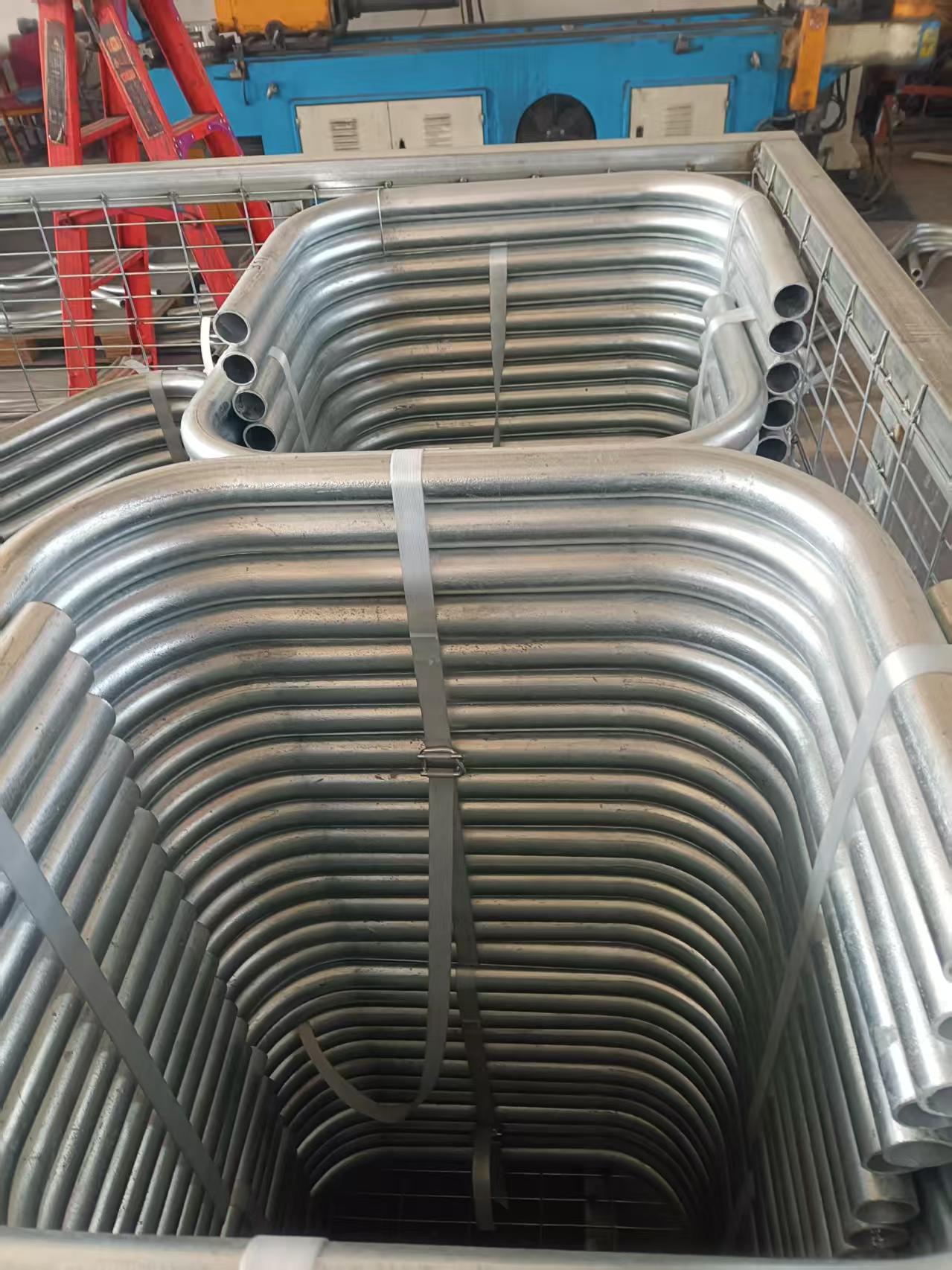
One important difference between a Hot-Dip Galvanized Handrail Termination and a painted railing termination is that the final detail must be compatible with the galvanizing process. Hot-dip galvanizing is not simply a coating applied to the outside surface. The fabricated component passes through pretreatment stages and molten zinc, so air, process liquids, and zinc must be able to move safely through hollow sections.
For this reason, vent and drain holes need to be considered during fabrication. If a hollow member is completely sealed without appropriate process openings, it can affect galvanizing quality and increase process risk.
A more practical fabrication sequence is usually:
- confirm termination positions from platform and stair drawings;
- complete tube cutting, returns, and connection details;
- finish welding and edge preparation;
- provide necessary venting and drainage openings;
- hot-dip galvanize the complete fabricated assembly;
- install the finished railing on site.
This approach is usually more reliable than galvanizing first and then cutting or welding the railing again on site. It helps maintain a more continuous corrosion-protection layer and reduces the need for local repair.
Weld Finishing Is Not Simply About Making the Weld Invisible
Handrail terminations often involve welded end plates, return pieces, or post connections, so weld quality directly affects both galvanizing and long-term service. Some projects place too much emphasis on making the weld completely invisible through heavy grinding, but excessive grinding does not necessarily produce a better result.
For a railing that will be hot-dip galvanized, the welding area should mainly achieve several practical objectives:
- provide reliable structural connection;
- remove obvious slag and sharp projections;
- minimize pockets where water can collect;
- avoid edges that can catch clothing or equipment;
- maintain a surface condition suitable for galvanizing.
In other words, the objective is to balance structural reliability, corrosion protection, and user contact rather than focusing only on a perfectly smooth appearance.
Handrail Termination Should Be Designed Together With Steel Grating Platforms and Stairs
In industrial projects, railings rarely work as isolated components. They are usually combined with Steel Grating Platforms, Stair Treads, Support Frames, and other steel structures to form a complete access and maintenance system. For this reason, the location of the handrail termination must also coordinate with the platform, stairs, removable covers, and supporting framework below.
For example, a handrail end that extends too far beside a removable grating panel may interfere with lifting the panel during maintenance. A termination positioned too far inward at a stair landing may reduce usable access width. Around equipment openings, ignoring the direction in which personnel and tools need to move can also create unnecessary interference.
The following relationships should be checked during the fabrication drawing stage:
| Related Structure | Relationship With Handrail Termination |
|---|---|
| Steel grating platform | Defines railing boundary and post position |
| Stair treads | Influences railing start, end, and direction |
| Access opening | Requires sufficient entry and opening space |
| Removable cover | Termination should not interfere with lifting |
| Support frame | Provides fixing and load-transfer points |
| Equipment and piping | Influences rail length and return direction |
Coordinating these components within the same fabrication drawing is usually more efficient than manufacturing the railing, grating, and stairs separately and then adjusting them on site.
The Value of Custom Termination Is Avoiding Site Conflicts
Standard railing arrangements work well on regular rectangular platforms, but industrial facilities often include tanks, piping, valves, pumps, drainage channels, irregular platforms, and structures at different elevations. In these cases, a standard termination may not fit the actual space.
A custom Hot-Dip Galvanized Handrail Termination can be adjusted in length, return direction, connection position, and relationship with the supporting frame. It can also be fabricated together with steel grating platforms, stair treads, and other customized steel components according to project drawings.
The purpose of customization is not to make the railing more complicated. It is to prevent standard details from conflicting with the real structure. This is especially valuable in retrofit projects where existing equipment occupies much of the available space.
A Good Handrail Termination Should Still Perform Well Years Later
A railing termination should not be judged only by how neat it looks immediately after installation. Its real value becomes clearer after several years of service. A well-designed Hot-Dip Galvanized Handrail Termination should not gradually become an obvious maintenance problem.
Long-term performance can be reviewed through several practical questions:
- Is there visible corrosion around the termination?
- Is water accumulating inside hollow members?
- Have weld areas become concentrated corrosion points?
- Do workers regularly bump into or avoid the railing end?
- Does the termination interfere with grating, cover, or equipment maintenance?
- Has repeated field modification created areas that need frequent repair?
If these problems do not develop over time, the termination is likely well matched to the structure, environment, and actual use of the access system.
Conclusion
Hot-Dip Galvanized Handrail Termination occupies only a small part of the complete railing system, but it connects structural design, pedestrian movement, corrosion protection, welding, galvanizing, and site installation.
A good termination does more than provide a neat end to the handrail. It should avoid projecting hazards, reduce unnecessary water entry, remain compatible with the hot-dip galvanizing process, minimize field modification, and coordinate properly with steel grating platforms, stairs, access openings, and supporting frames.
For this reason, a reliable termination should not be decided at the final stage of production. It should be defined during fabrication drawing development together with the rest of the project structure. The value is not only a cleaner appearance, but also fewer corrosion, interference, and maintenance problems over the long term.
FAQ
1. Why should Hot-Dip Galvanized Handrail Termination be designed before galvanizing?
Because the termination affects cutting, welding, venting, drainage, galvanizing, and site installation. Completing the main fabrication before galvanizing helps reduce later cutting and maintain more continuous corrosion protection.
2. Should every hollow galvanized handrail end be completely sealed?
Not necessarily. In addition to limiting water entry, the design needs to consider internal drainage, venting, and the process openings required for hot-dip galvanizing.
3. Can a hot-dip galvanized handrail still be cut on site?
Yes, but cutting or welding damages the local zinc coating, so the affected area requires suitable corrosion-protection repair. Where possible, major fabrication should be completed before galvanizing.
4. Can Hot-Dip Galvanized Handrail Termination be customized together with steel grating platforms?
Yes. Rail ends, posts, return sections, steel grating platforms, stair treads, and support frames can be coordinated according to the overall engineering drawing so the final system better matches actual access routes and equipment layouts.
Post time: Sep-01-2026