
Heavy Duty Steel Grating is designed for applications where standard grating may not provide enough structural capacity or service performance. The need for a heavy-duty solution is usually determined by the actual loading condition, support span, traffic, and operating environment rather than by the size of the facility alone.
A pedestrian walkway, for example, may only carry distributed personnel loads, while an industrial platform can also support machinery, maintenance equipment, pallets, or vehicles. Using the same grating specification across all these areas may result in unnecessary material use in some locations and insufficient performance in others. The better approach is to identify where demanding loads actually occur and design those areas accordingly.
When Does Standard Steel Grating Become Insufficient?
Standard grating may no longer be suitable when an area is exposed to concentrated loads, repeated vehicle traffic, heavy equipment, or relatively long support spans. These conditions can create greater bending and deflection than ordinary pedestrian use.
Typical applications that may require closer structural consideration include equipment platforms, forklift routes, machinery support areas, heavy maintenance zones, and industrial access structures. The decision should be based on the actual working conditions rather than simply choosing a product labeled “heavy duty.”
For example, a machine may transfer its weight through several small mounting points. A forklift transfers its load through its wheels. Both conditions are very different from a group of workers walking across the platform, even if the total weight involved appears similar.
Load Distribution Is Critical to Grating Design
The total weight carried by a platform does not tell the whole story. How the load reaches the bearing bars can have a major effect on the required grating configuration.
Distributed loads are generally less demanding than concentrated loads applied over a small contact area. Equipment feet, vehicle wheels, support brackets, and stored materials can all create localized pressure that needs to be considered during design.
Support span is another important factor. The same steel grating panel can behave differently when installed over closely spaced beams compared with a much wider opening. As the span increases, deflection and bending become more significant under the same load.
For this reason, heavy-duty grating should be selected by considering bearing bar dimensions, spacing, support conditions, and load type together rather than by panel weight alone.
Forklift and Vehicle Traffic Require Special Attention
Vehicle traffic creates one of the clearest situations where ordinary pedestrian grating may not be enough. Forklift wheels apply concentrated loads over relatively small contact areas, while repeated movement can introduce dynamic effects and accelerate wear if the floor system is not properly designed.
When forklifts or maintenance vehicles will travel directly over grating, the design should consider wheel loads, wheel spacing, travel routes, support spans, and panel configuration. Depending on the project, a heavy-duty grating section may be appropriate, while another area may require additional structural reinforcement or a different floor solution.
The important point is to define the traffic zone before selecting the grating. A project does not necessarily need heavy-duty grating across the entire platform simply because forklifts operate in one section.
Heavy Equipment May Require Local Reinforcement
Industrial platforms often contain pumps, motors, compressors, filters, pipe supports, and other equipment. These loads are frequently transferred through specific mounting points rather than evenly across the platform.
In such situations, simply upgrading the entire floor may not be the most efficient solution. The equipment area may instead require stronger bearing bars, shorter support spans, local reinforcement, or a dedicated support frame.
This is where custom heavy duty steel grating can provide practical value. Panel dimensions, bearing bar specifications, openings, and edge treatments can be coordinated with the equipment layout so that the grating works with the surrounding structure rather than being treated as an independent component.
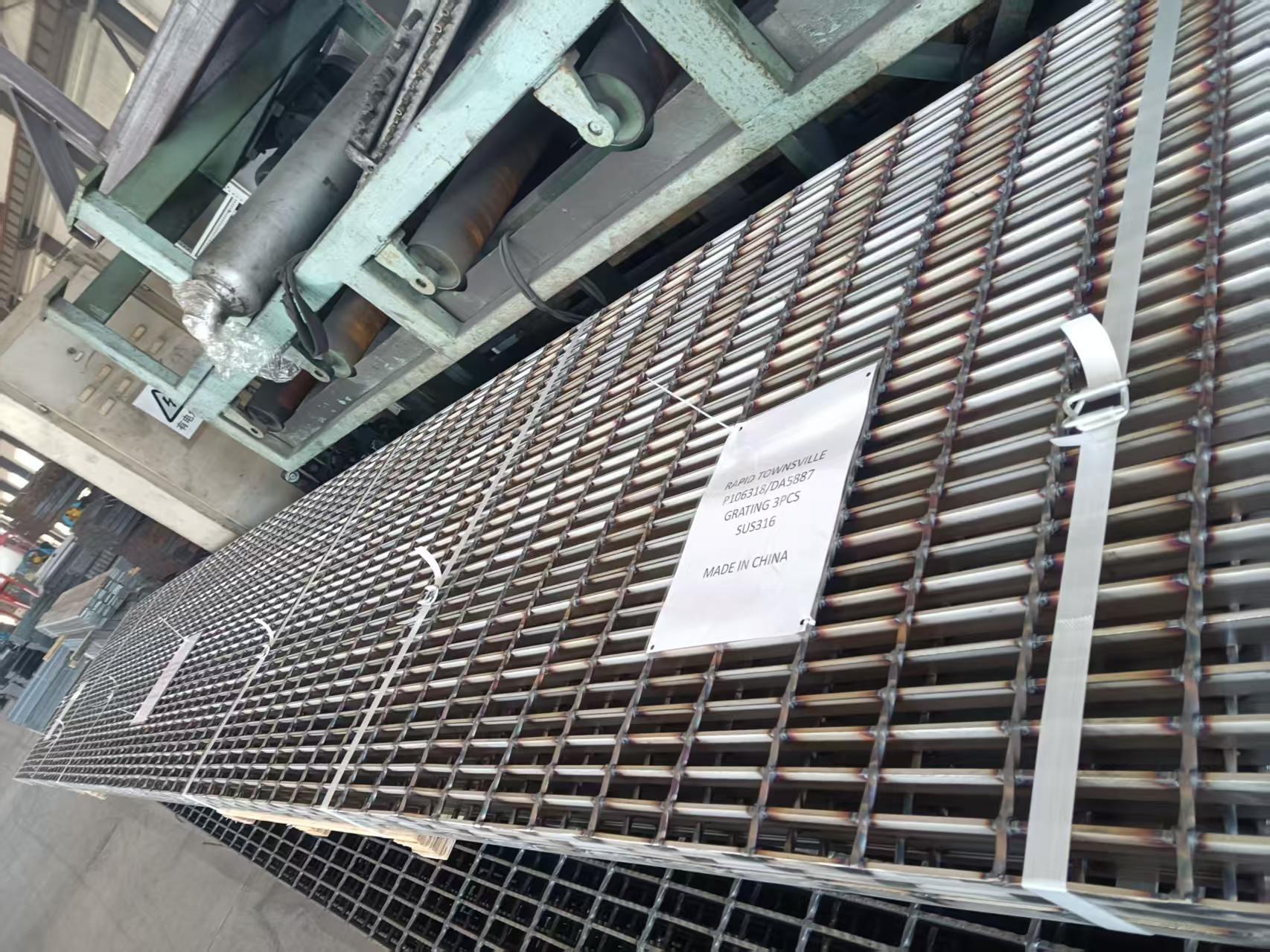
Deflection Matters in Long-Term Use
Structural strength is important, but service performance also needs attention. Excessive deflection can make an industrial platform feel unstable and may contribute to vibration, noise, or maintenance problems during repeated use.
A suitable heavy-duty design therefore needs to consider both the expected load and how the platform should behave under that load. Making every panel heavier is not necessarily the solution. Matching the grating structure to the actual support span and operating condition is generally more effective.
For existing platforms, visible deformation or recurring damage can also provide useful information when upgrading the grating. Instead of simply replacing damaged panels with heavier ones, it is worth identifying whether the underlying issue is related to loading, support spacing, vehicle traffic, or local equipment loads.
Heavy Duty Grating for Outdoor and Corrosive Environments
Load capacity is not the only consideration in demanding industrial applications. Outdoor platforms and facilities exposed to moisture, chemicals, or wastewater also require appropriate corrosion protection.
Hot-dip galvanized heavy duty steel grating is commonly used for outdoor industrial platforms, walkways, wastewater facilities, energy projects, and other environments where steel components are exposed to weather or corrosive conditions. Galvanizing provides a protective zinc coating that helps extend the service life of carbon steel grating.
Where the environment is particularly aggressive, material selection may need to go beyond galvanized carbon steel. Stainless steel grating can be considered for applications where higher corrosion resistance is required. The appropriate material should be determined by the actual environment, maintenance requirements, and expected service life.
Should the Entire Platform Use Heavy Duty Steel Grating?
Not necessarily. Many industrial projects contain different load zones, and using one specification everywhere can create unnecessary cost and material consumption.
| Application Area | Typical Condition | Possible Grating Approach |
|---|---|---|
| Personnel walkway | Distributed pedestrian loads | Standard grating |
| Equipment area | Concentrated loads | Heavy-duty or locally reinforced grating |
| Forklift route | Repeated wheel loads | Heavy-duty design |
| Outdoor access platform | Load plus weather exposure | Galvanized grating |
| Highly corrosive area | Chemical or moisture exposure | Galvanized or stainless steel, depending on conditions |
This zoning approach allows the project to allocate stronger grating where it provides a genuine benefit while keeping lower-load areas appropriately specified. It can also simplify future maintenance because demanding sections can be identified and managed separately.
A Complete Heavy-Duty Grating Solution
A heavy-duty grating project involves more than selecting a stronger bearing bar. Panel dimensions, support conditions, openings, fixing methods, surface treatment, access requirements, and surrounding steel structures can all affect installation and long-term performance.
For projects with multiple operating zones, it can be useful to coordinate heavy-duty panels with standard grating, stair treads, trench covers, serrated surfaces, fixing accessories, and other fabricated components. This creates a more consistent access system while allowing individual areas to be designed according to their actual requirements.
Heavy Duty Steel Grating from First Steel Grating
First Steel Grating provides Heavy Duty Steel Grating for industrial platforms, equipment areas, access structures, vehicle routes, and other demanding applications.
Its capabilities include customized panel dimensions, bearing bar specifications, serrated surfaces, hot-dip galvanized finishing, stair treads, trench covers, and related fixing components. For projects containing both normal and heavy-load areas, different grating configurations can be coordinated according to the actual use of each zone.
The practical objective is not to make every section heavier, but to provide the right grating structure for each working condition.
The Right Grating Starts With the Actual Working Condition
Heavy-duty steel grating should be selected according to how a platform will actually be used. Concentrated equipment loads, forklift traffic, support spans, environmental exposure, and maintenance requirements can all change the appropriate specification.
When these conditions are identified early, the project can avoid two common problems: under-specifying areas that face demanding loads and over-specifying areas that do not need additional capacity. A properly planned system uses heavy-duty grating where it solves a real structural requirement while keeping other areas practical and economical.
FAQ
1. What is Heavy Duty Steel Grating used for?
Heavy Duty Steel Grating is commonly used for equipment platforms, forklift routes, heavy maintenance areas, industrial access structures, and other applications exposed to concentrated or repeated loads.
2. What determines whether heavy-duty grating is required?
The main factors include load type, concentrated load location, support span, traffic conditions, grating configuration, and the surrounding operating environment. Panel weight alone is not enough to determine suitability.
3. Can standard and heavy-duty grating be used in the same project?
Yes. Different sections can use different grating specifications according to their actual load and operating conditions. This can reduce unnecessary over-specification while providing additional capacity where required.
4. Can Heavy Duty Steel Grating be customized?
Yes. Heavy-duty grating can be customized in terms of panel dimensions, bearing bar specifications, surface type, openings, edge treatment, and hot-dip galvanized finishing. Related products such as stair treads, trench covers, and fixing components can also be coordinated for the project.
Post time: Sep-24-2026