
This is why anti-slip performance should not be judged only by whether a surface feels rough. A walkway that performs well on a flat, dry section may become much less reliable on a slope, near a leaking pump, or where oil and fine dust collect. Drainage, surface profile, opening size, transition points, and cleaning conditions all influence how safely people can move through the route.
An Anti-Slip Walkway Is Only as Reliable as Its Weakest Section
A common problem in industrial access systems is that individual sections are designed separately. The main walkway may use an anti-slip surface, while the connecting stair, ramp, drainage cover, or maintenance platform follows a different standard.
The result is a route where walking conditions suddenly change.
| Walking Transition | How the Risk Changes | What Deserves Attention |
|---|---|---|
| Dry floor to wet process area | Surface friction drops quickly | Drainage and surface grip |
| Flat walkway to ramp | Forward sliding force increases | Surface profile and slope |
| Walkway to stair | Foot placement becomes more critical | Tread grip and edge visibility |
| Walkway across drainage channel | Openings affect foot and wheel contact | Grid size and support |
| Main route to equipment platform | Contamination may increase | Cleaning access and removable panels |
The goal is therefore not to maximize slip resistance at one point, but to avoid creating a sudden weak point somewhere else along the route.
Flat Floors and Slopes Do Not Create the Same Walking Risk
On a level walkway, the main slip risk usually comes from contamination between the footwear and the surface. Water, oil, coolant, mud, or fine process residue can reduce friction.
On a slope or ramp, the same contamination becomes more serious because part of the person’s weight is already acting in the direction of movement. A surface that feels acceptable when flat may provide noticeably less confidence when installed on an incline.
This means the location of the Anti-Slip Walkway matters as much as the surface itself.
For ramps and inclined access routes, the design should consider how steep the route is, whether workers carry tools or components, how often the surface becomes wet, and whether liquid can leave the walking area instead of flowing down the entire slope.
A rougher surface helps, but drainage often matters just as much. If water or oil continuously forms a film over the walkway, surface texture alone may not solve the problem.
The Type of Contamination Changes the Best Solution
Not all slippery surfaces behave in the same way.
Water can often drain quickly through an open steel grating. Oil is more difficult because a thin film may remain on the bearing bars. Mud and sludge can fill surface texture, while fine powder can reduce friction even when the walkway looks dry.
For that reason, the walking environment should be considered according to the type of material likely to reach the surface.
Water and rain generally favor an open structure that allows quick drainage.
Oil and lubricants require good drainage but also benefit from a more pronounced surface profile.
Mud and sludge make cleaning access important because accumulated material can cover the anti-slip features.
Fine dust or powder may require more frequent housekeeping because texture alone cannot compensate for a heavily contaminated surface.
This distinction makes Anti-Slip Walkway design more practical than simply specifying “serrated” for every industrial area.
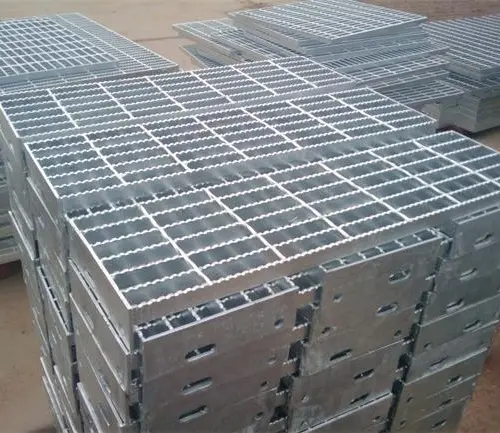
Why Serrated Steel Grating Works Well in Many Industrial Routes
Serrated Steel Grating is widely used for anti-slip industrial access because the raised serrated edges provide additional contact points between the footwear and the bearing bars.
Its open-grid construction also allows water, washdown liquid, and part of the process residue to pass through rather than remain on the walking surface.
This combination is useful around pumps, wastewater systems, chemical equipment, outdoor machinery, production lines, and elevated maintenance routes.
However, serration should not be viewed as a substitute for good drainage or cleaning. If the openings below become blocked or thick residue builds up over the serrated edges, the intended surface benefit gradually decreases.
The most effective anti-slip walkway therefore combines surface grip with a way to remove contamination.
Stairs Should Feel Like a Continuation of the Walkway
One of the most critical transitions in an industrial route occurs where a walkway meets a stair.
Workers approaching a stair may still be carrying tools, looking toward equipment, or moving from a wet process zone. The first tread therefore needs to provide predictable contact rather than suddenly changing to a smoother surface.
Steel grating stair treads can maintain the open drainage characteristics of the main walkway, while serrated tread surfaces can provide additional grip where required.
Tread edges also matter because users need to recognize where one step ends and the next begins, especially in areas with limited lighting, moisture, or heavy equipment around the stair.
Treating the stair and walkway as one access system creates a more consistent walking condition than selecting them independently.
Openings Need to Work With Feet, Tools, and Small Wheels
Anti-slip performance is not only about surface friction. The geometry of the walkway also affects how people move across it.
Very large grid openings can provide excellent drainage, but they may be less comfortable for frequent pedestrian traffic and can create problems for narrow wheels, small maintenance carts, or dropped tools.
Very small openings may improve foot support but can hold more dirt or restrict drainage in heavily contaminated environments.
The correct opening therefore depends on what actually travels across the route. A maintenance walkway used only by workers may have different priorities from an access route that also carries trolleys or service equipment.
This is particularly important around drainage channels, where the walkway needs to remain stable while still allowing liquids to leave the area efficiently.
Cleaning Is Part of Anti-Slip Performance
A walkway does not remain in its original condition forever.
Process residue, corrosion products, dust, mud, and oil can gradually change the surface. Even a well-designed anti-slip grating may become less effective if it cannot be cleaned easily.
This makes maintenance access part of the walkway design.
Open grating can simplify washdown because liquids pass through the surface, but the area underneath must also be accessible where residue is likely to accumulate. Around equipment, removable panels can make periodic cleaning and inspection easier.
In heavily contaminated environments, a surface that is easy to restore to a clean condition can be more valuable over time than one that relies only on an aggressive initial texture.
Designing One Continuous Anti-Slip Route
A practical Anti-Slip Walkway system may combine several steel products rather than relying on one panel type everywhere.
General industrial routes can use press-welded grating where contamination is limited. Wet or oily sections can transition to Serrated Steel Grating, while stairs can use matching steel grating treads. Drainage crossings may use removable trench covers, and equipment platforms can be shaped around pipes, valves, or machinery.
For higher-load sections, heavier bearing bars can be introduced without changing the entire route to Heavy Duty Steel Grating.
Custom panel dimensions, openings, edge treatment, steel frames, and supporting components can also be coordinated according to the layout. The useful principle is to keep the walking experience consistent even when the structure underneath changes.
Conclusion
An Anti-Slip Walkway should not be evaluated as a single rough surface. Safe industrial access depends on how the route behaves as people move between dry and wet areas, flat floors and ramps, walkways and stairs, drainage crossings, and equipment platforms.
Surface profile is important, but drainage, contamination type, grid geometry, cleaning access, and transition design also influence long-term walking safety.
A well-designed anti-slip route does more than provide extra grip. It reduces sudden changes in walking conditions and keeps drainage, maintenance, and structural needs working together throughout the access system.
FAQ
1. Is Serrated Steel Grating always required for an Anti-Slip Walkway?
Not always. Serrated grating is especially useful in wet, oily, or contaminated areas, while dry low-risk routes may use standard grating if the walking conditions remain stable.
2. Why can an anti-slip surface still become slippery?
Oil, sludge, dust, or other residue can cover the surface profile and reduce effective grip. Drainage and regular cleaning are therefore important parts of anti-slip performance.
3. Should stairs use the same surface type as the walkway?
Where the walkway is wet or contaminated, using a compatible anti-slip stair tread helps maintain more consistent foot contact when users move from the walkway onto the stairs.
4. Does a larger grating opening improve an Anti-Slip Walkway?
Larger openings may improve drainage, but they can reduce foot comfort and create problems for small wheels or tools. Opening size should balance drainage with the actual traffic using the walkway.
Post time: Aug-25-2026